There are still some outstanding areas of work to complete before Furness Railway No. 20 can be steamed. Ron Crowe refitted the front guard irons, which had been removed for the engine’s recent trip to Barrow, and Tim has taken on board cleaning out the lockers in the tender – yes the clear-out was long overdue with a fair amount of rubbish found and disposed of! The lockers are receiving a fresh coat of paint before they are refilled with useful content! Alan and Sam have been concentrating on fitting the controls to the new injector steam valves, with the refitting of the main steam pipe also on their ‘to do’ list. 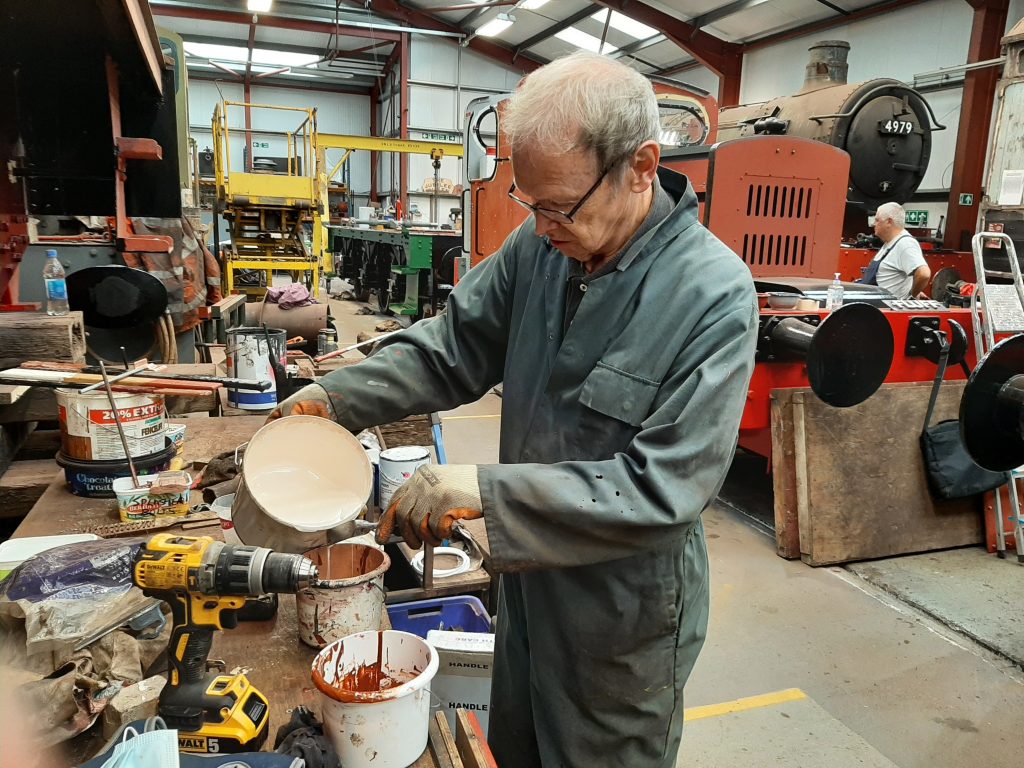 John Dixon has been continuing his expeditions into the tender tank, seen here mixing the two pack paint…
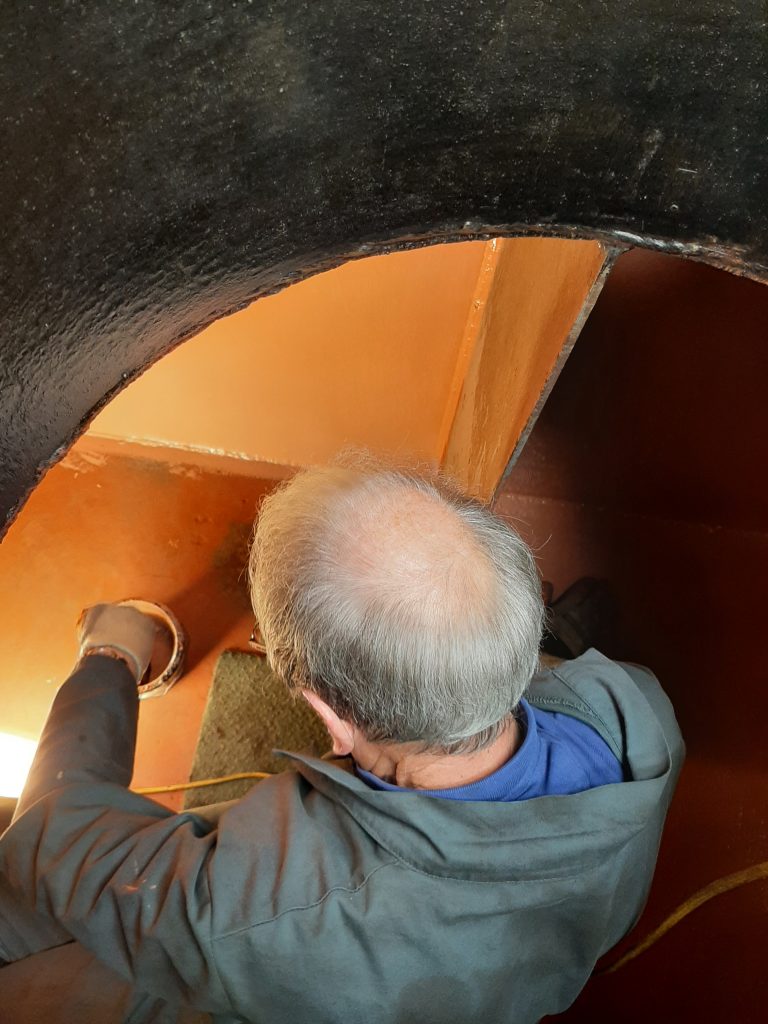 …and then applying it.
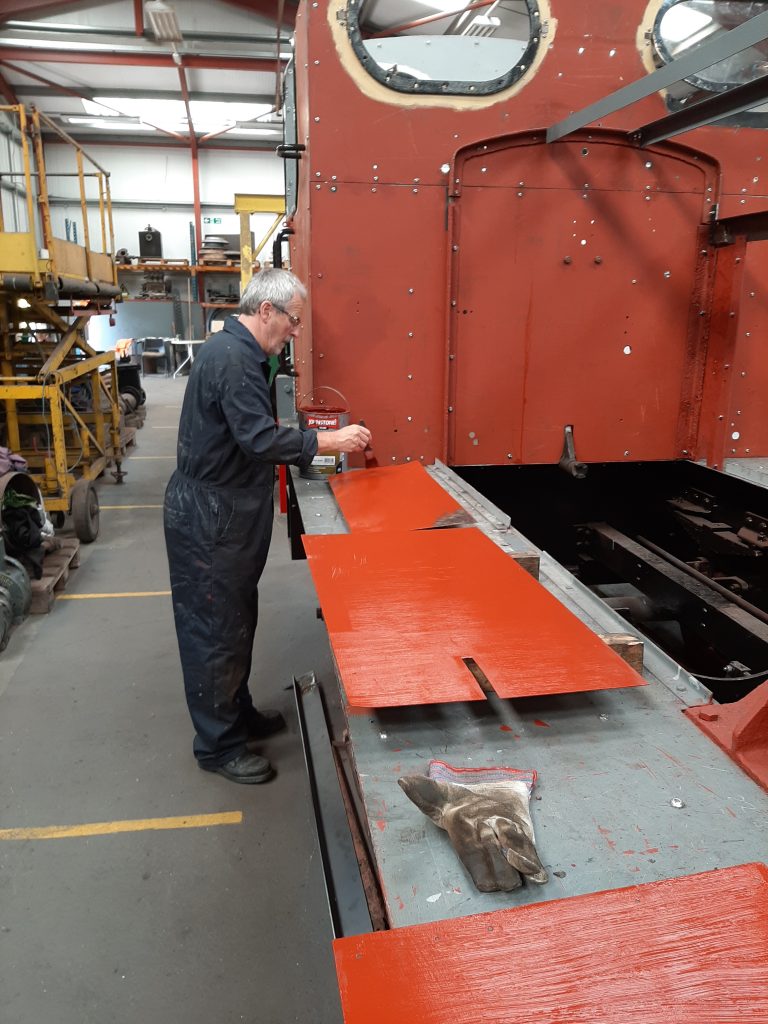 The Fluff gang has been busy test fitting side panels to the engine compartment. Paul Balshaw is seen here applying primer to one of the panels…
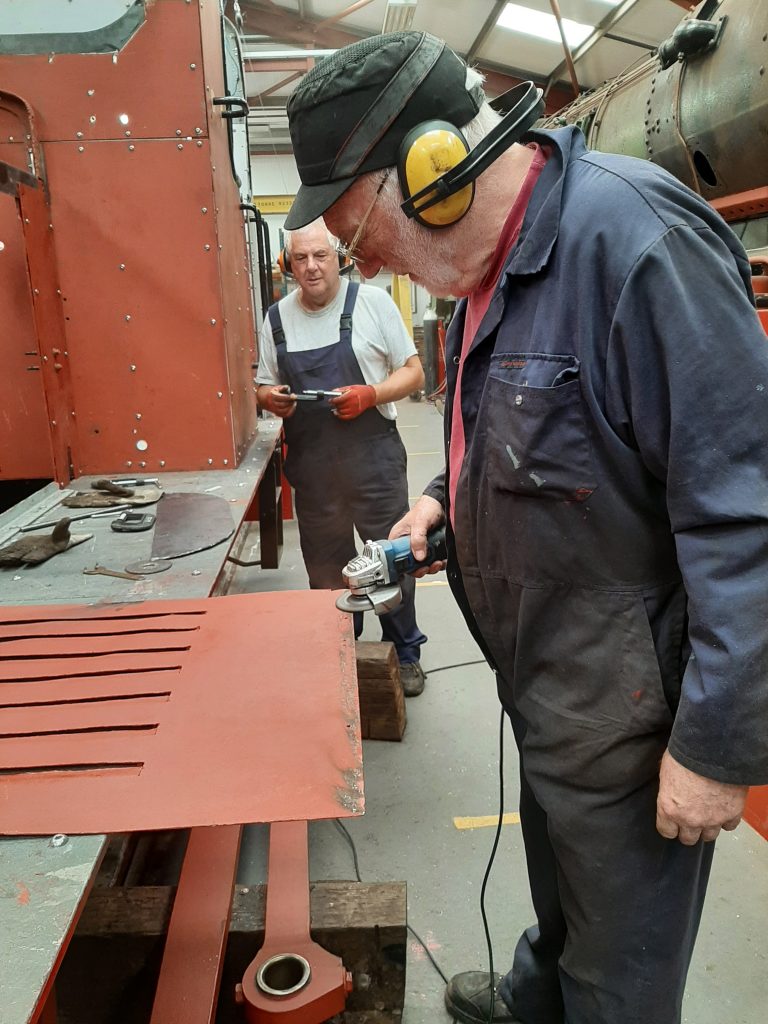 …whilst Phil Bell has been removing paint to make the panels fit correctly!
Ade has been test fitting Caliban‘s axleboxes.
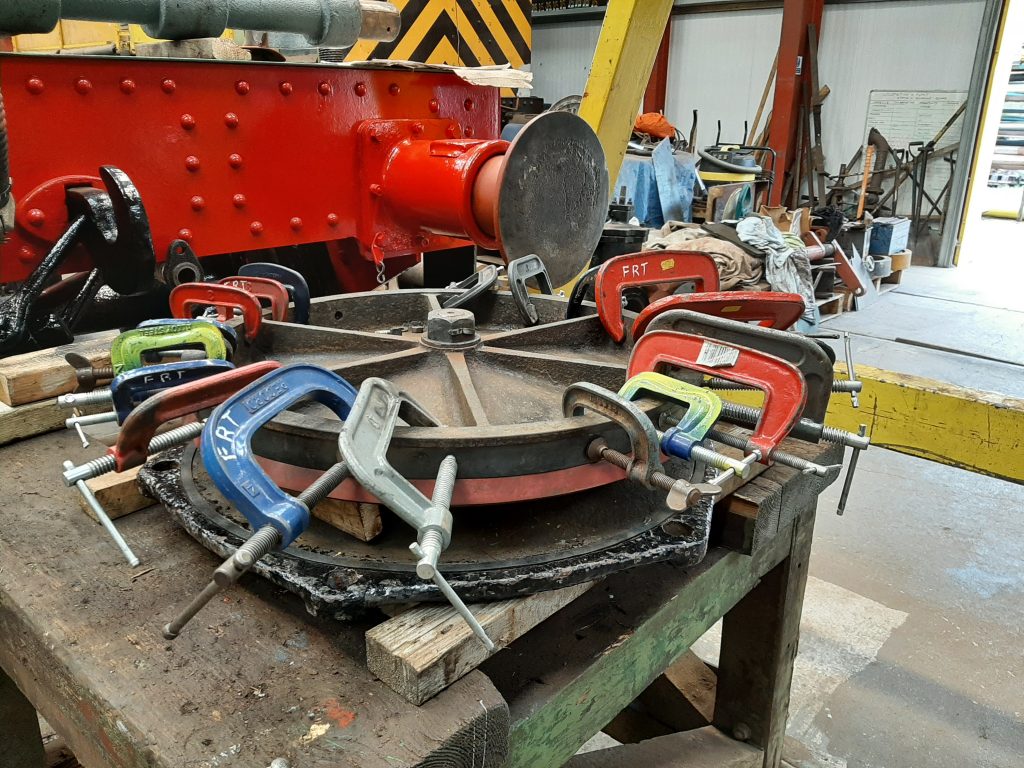 Keith has been renovating and assembling Wootton Hall‘s tender vacuum cylinder. First a new slipping band had to be fitted to the piston. This can be a frustrating exercise: the holes in the piston, the band and the steel band that keeps the slipping band in place have all to be lined up. ‘G’ clamps are the preferred method to achieve this and the FRT’s full complement of clamps were deployed to the task on Wednesday morning.
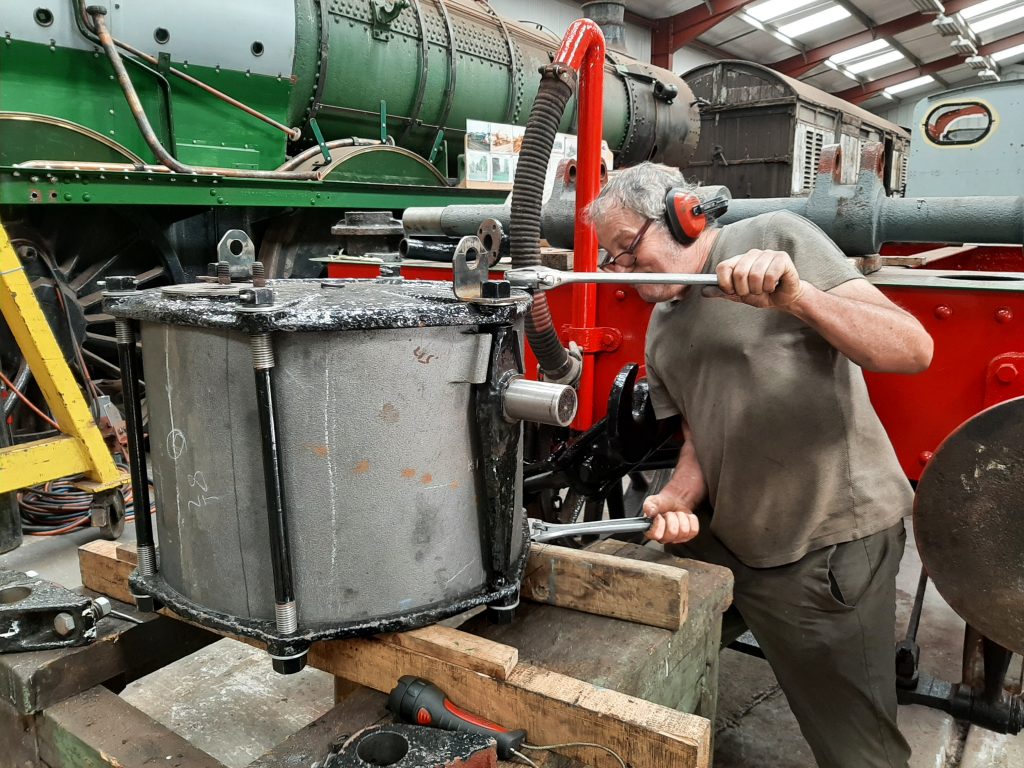 By Friday Keith had fitted the rubbing band, inserted the piston, fitted the sealing rings and was to be seen tightening up the top and bottom parts of the vacuum cylinder.
Keith reports that 5643 has again been busy at the East Lancs Railway, hauling ten coaches on Thursday. It is seen here leaving Bury on Friday with the dining train of six coaches.
Finally, when Tim was in an Ulverston bookshop this week he spotted a book entitled Ulverston, Festival town, with a very familiar face grinning at him from the front cover!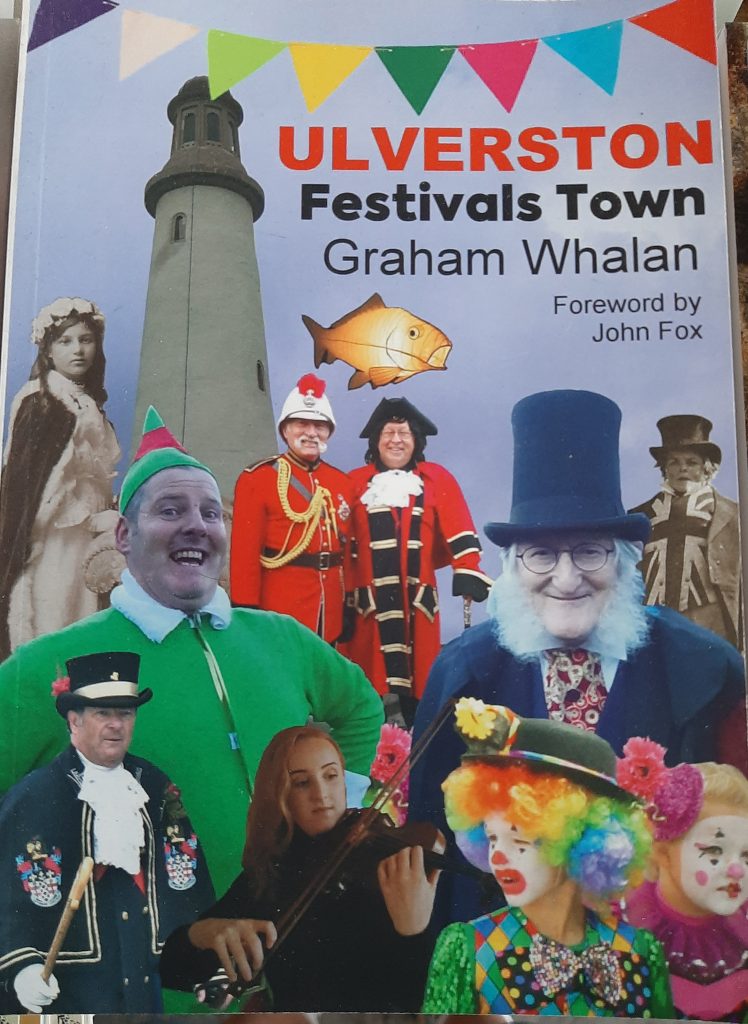
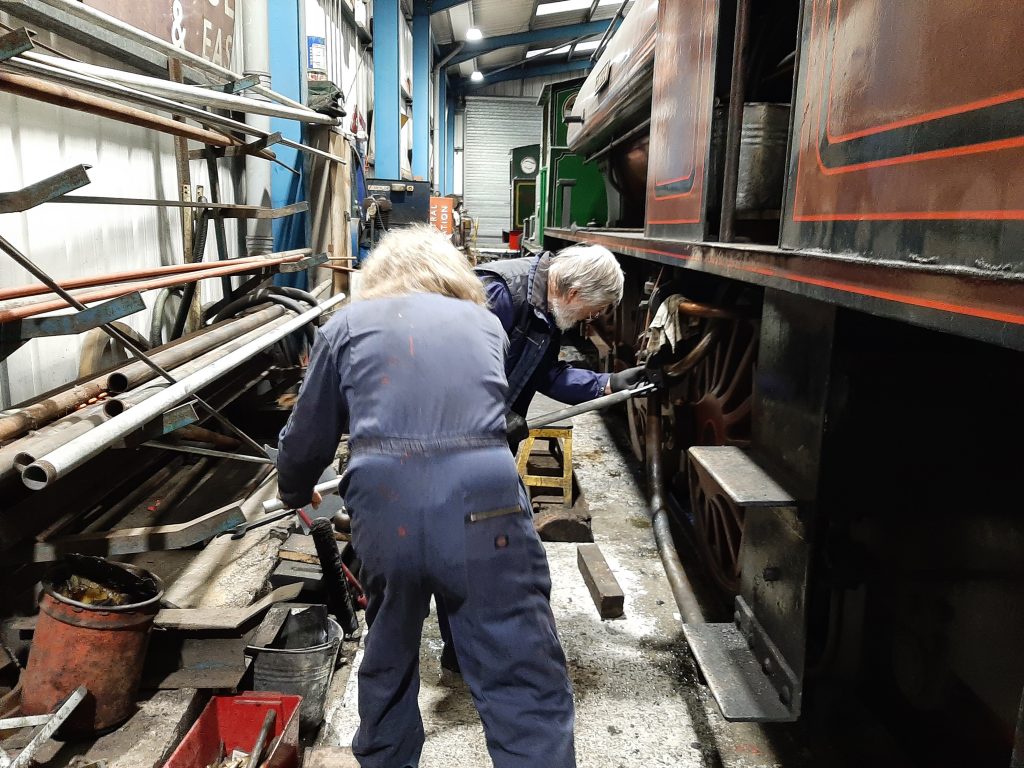 Last Wednesday saw yet another working party convene at Embsay in an effort to improve the performance of Cumbria‘s left hand injector. New parts had been fitted during the previous visit but the bottom cone had proved to be a tight fit and it had been decided not to put too much weight on it whilst being screwed into position. This time, on examination, there was far less resistance and, with the assistance of a length of pipe, Adrian was able to screw it until it reached the end of its thread.
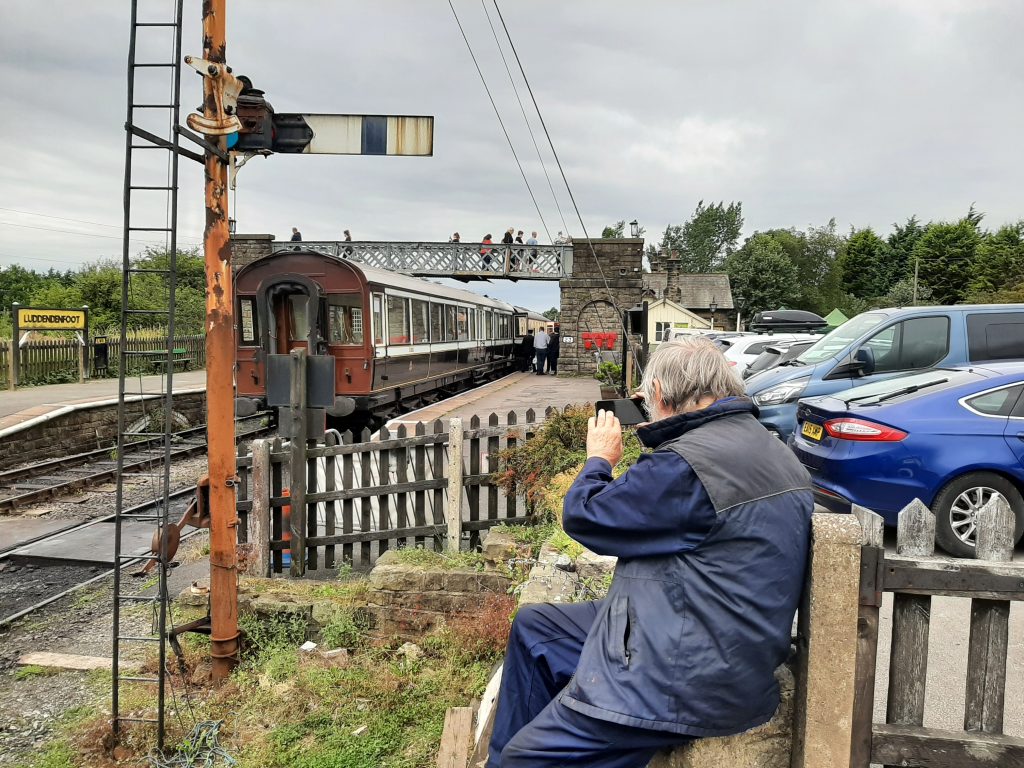 Tim caught Alan apparently taking a photo of the lovely L&NWR saloon.
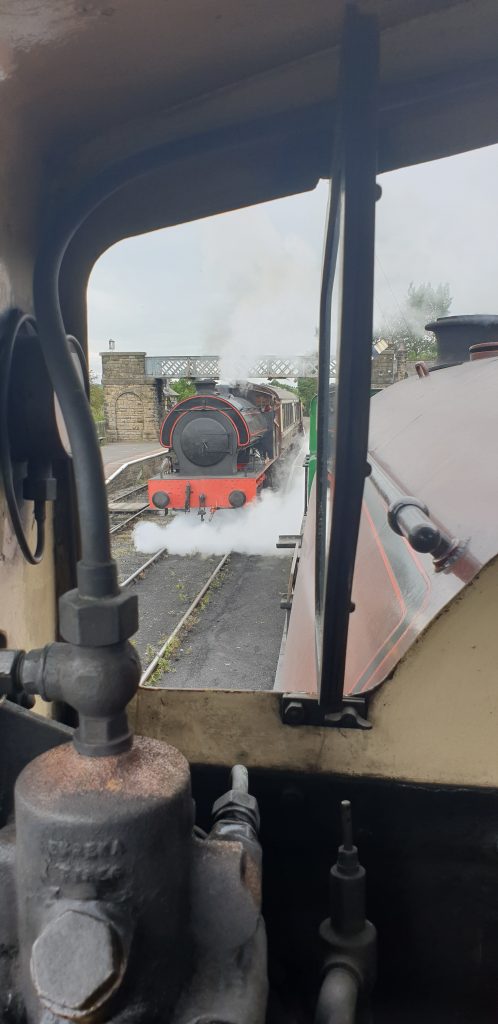 Meanwhile Ade contented himself with one of his artistic cab spectacle photos of Welsh Guardsman departing Embsay with a train to Bolton Abbey.
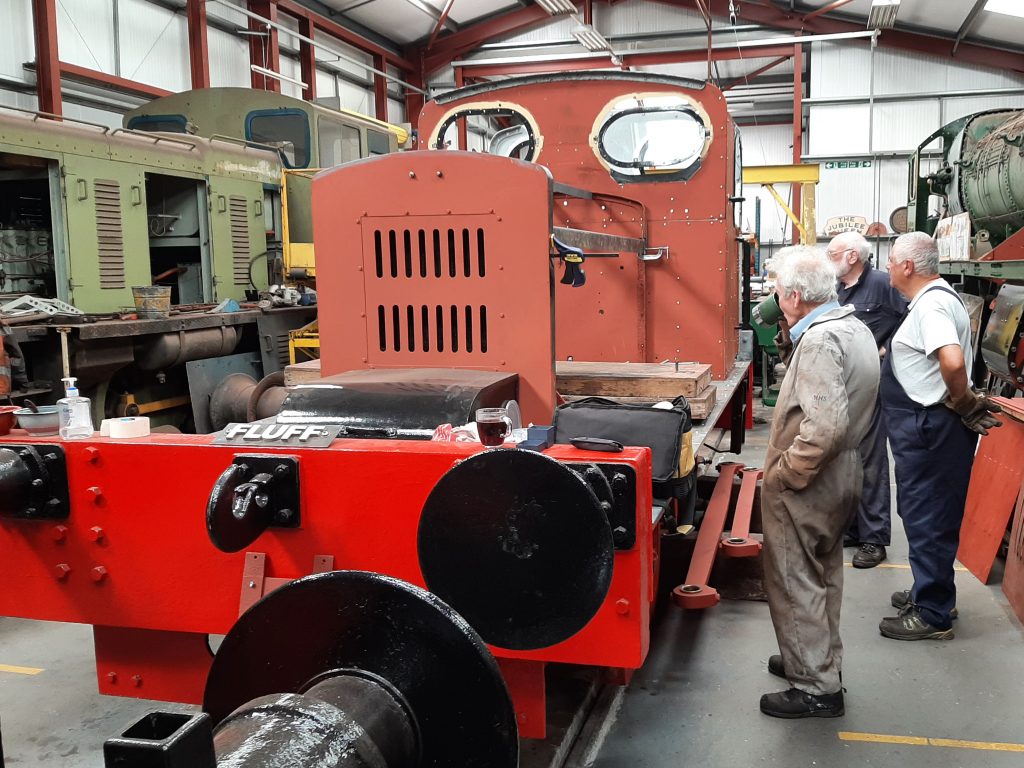 Back at Preston, the Fluff gang has again been busy. We see here a planning meeting on Friday – is this a new concept?!
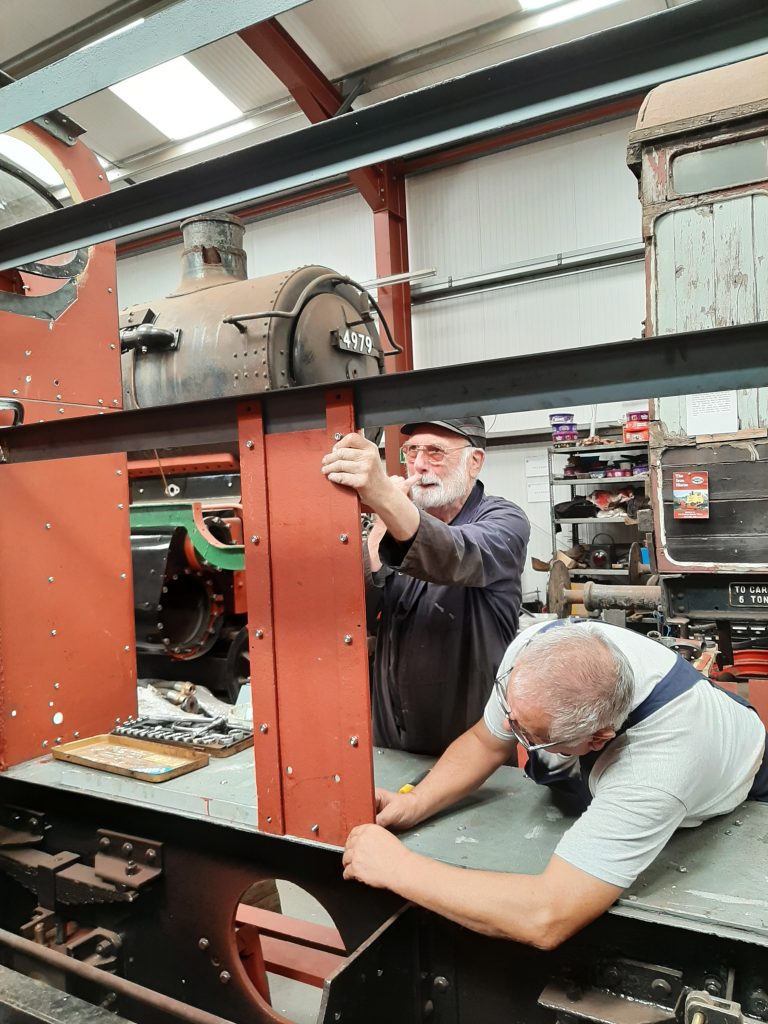 Phil and John Davis then set about test fitting the first side panel to the new angle support piece.
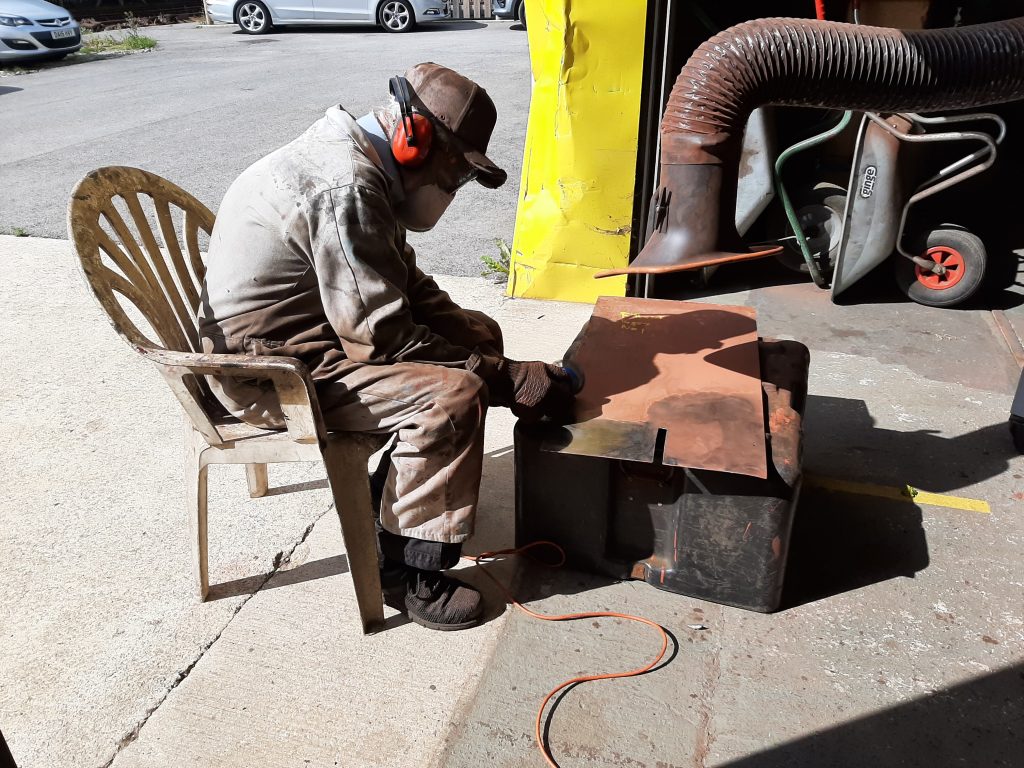 Fred then set about cleaning more of Fluff’s panels for painting.
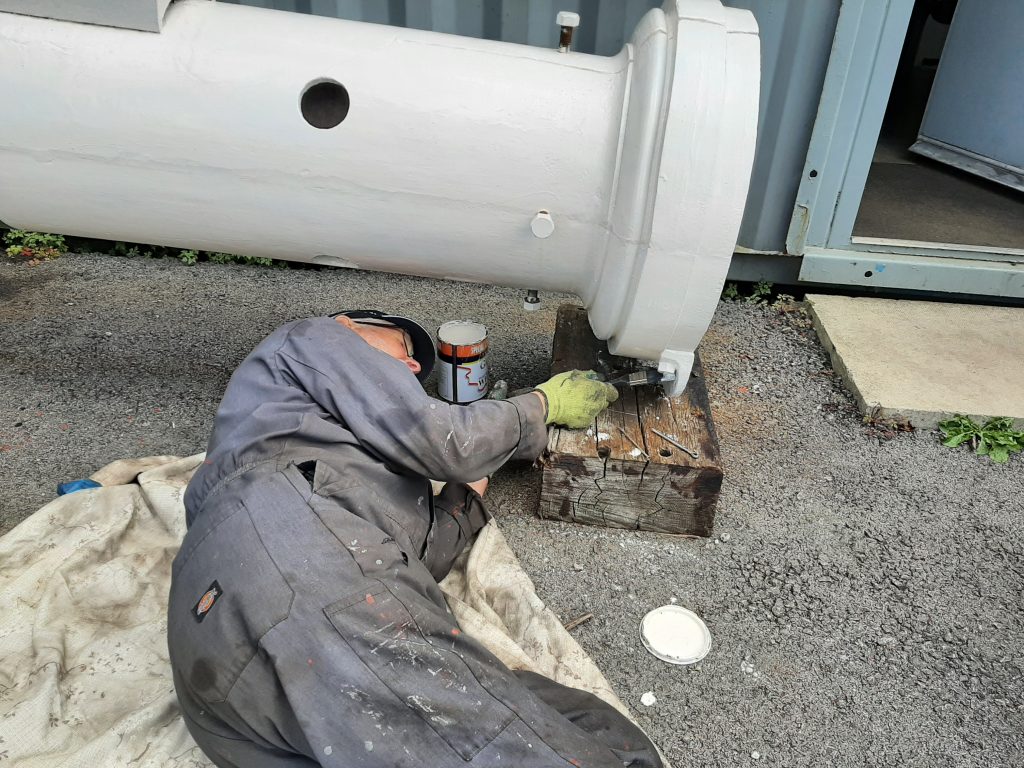 Meanwhile Roger took advantage of some better weather by continuing the paint job on the former Foxfield water column.
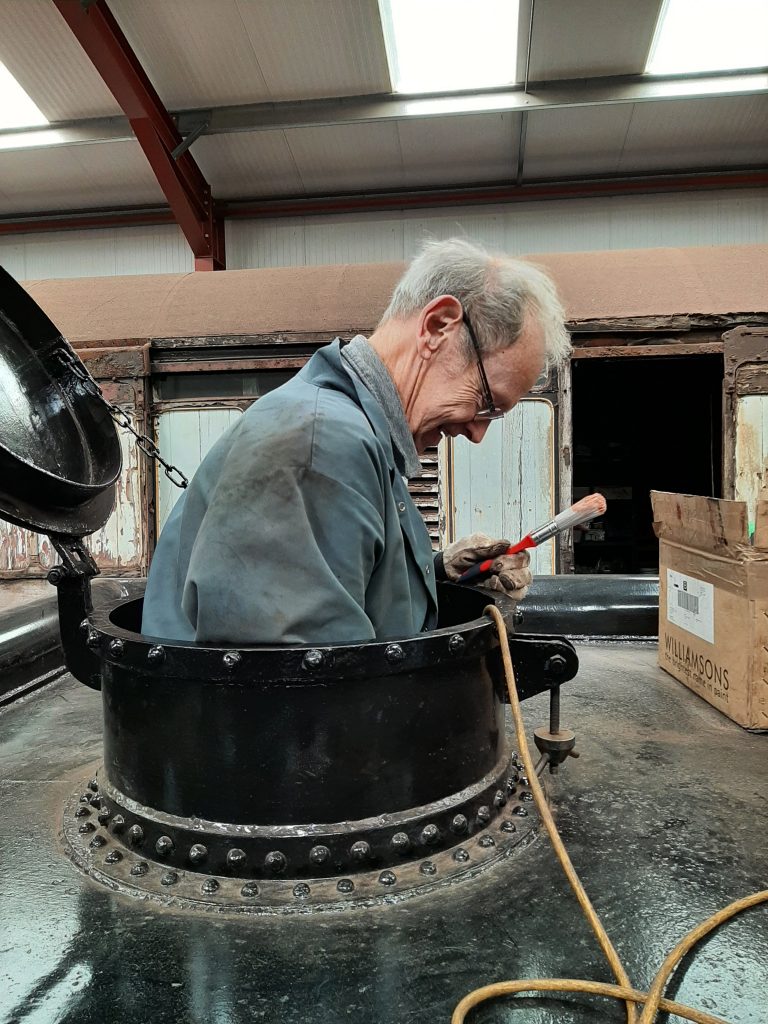 Work also continued on FR 20 where Stewart Waugh had applied some anti-corrosion solution to the tender coal space after which Tim added some grey undercoat. Having finished (and won!) his long running battle with fitting the engine’s vacuum pipe, John Dixon was busy on the inside of the tender tank applying some two pack paint, again to prevent future corrosion.
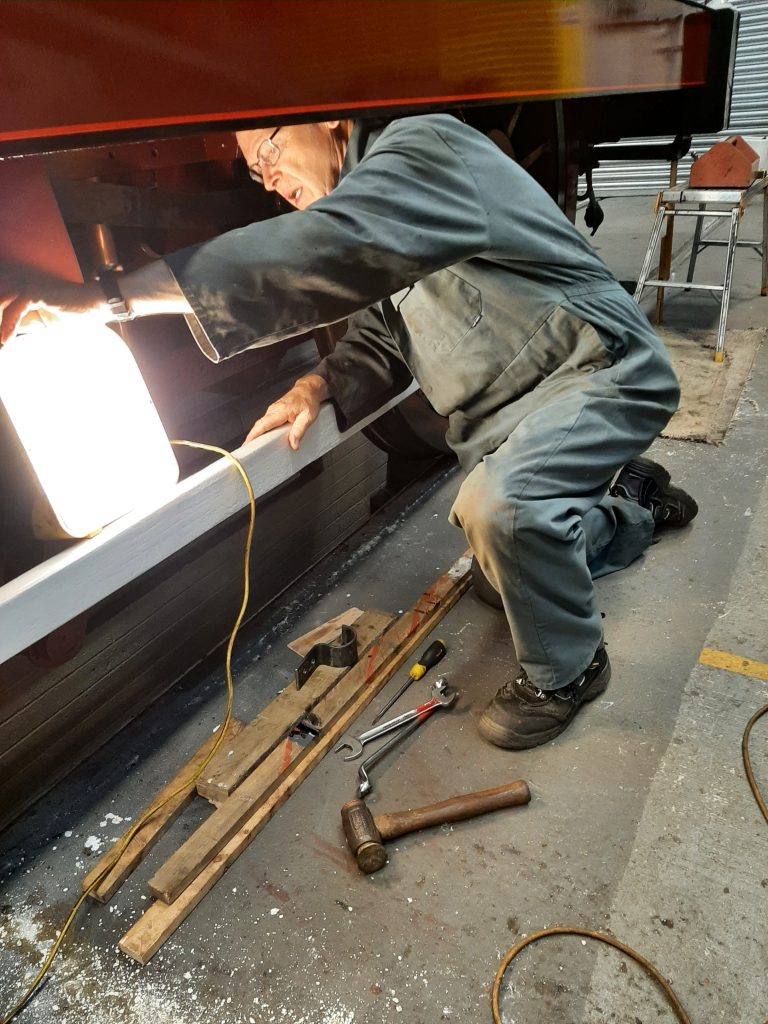 Further work has taken place on FR 20 with Tim tidying up some of the corrosion and paintwork on top of the tender and John Dixon still finding work to do on the engine’s vacuum pipe which is located under the right hand valance.
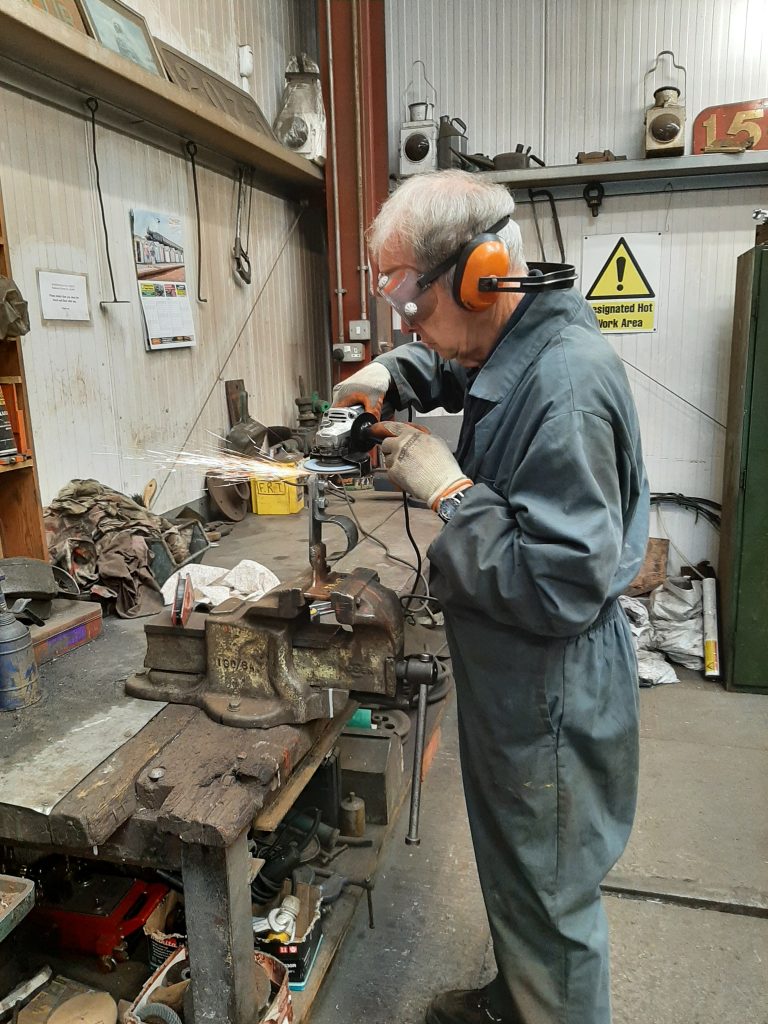 John has been fabricating two brackets to retain the vacuum pipe in place and is seen here removing sharp edges that could potentially cause harm to those working underneath the loco.
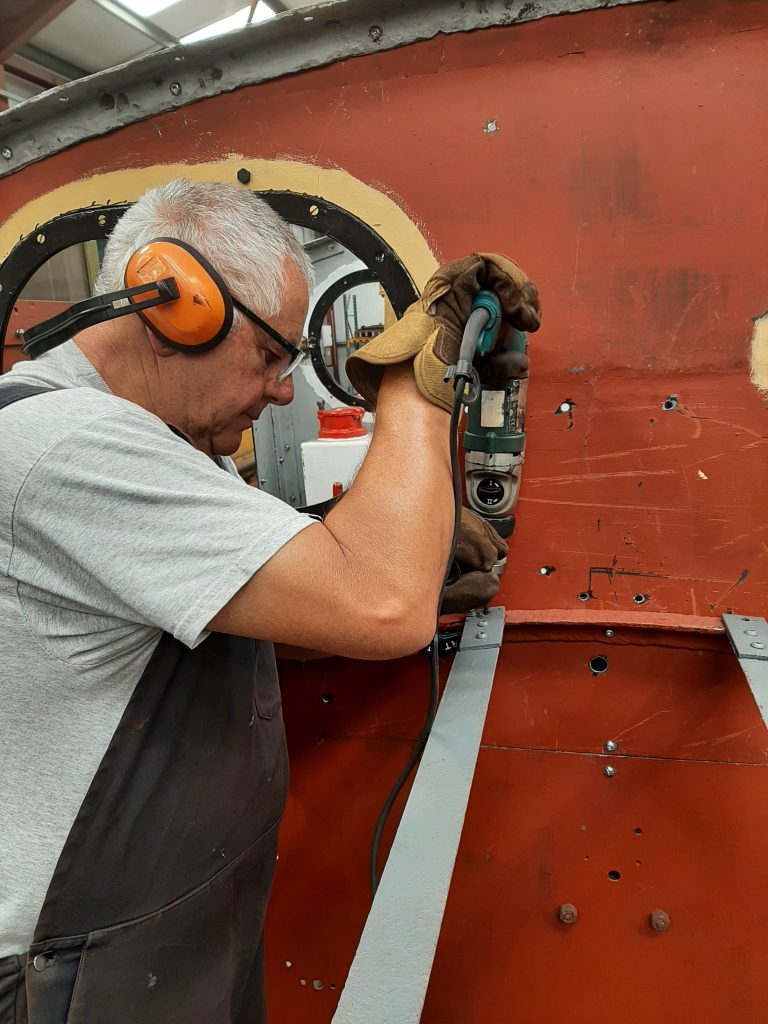 Work has also continued on Fluff with Phil Bell making some adjustments to the cab spectacle plate and John Davis drilling holes in the new angles which support the engine compartment roof.
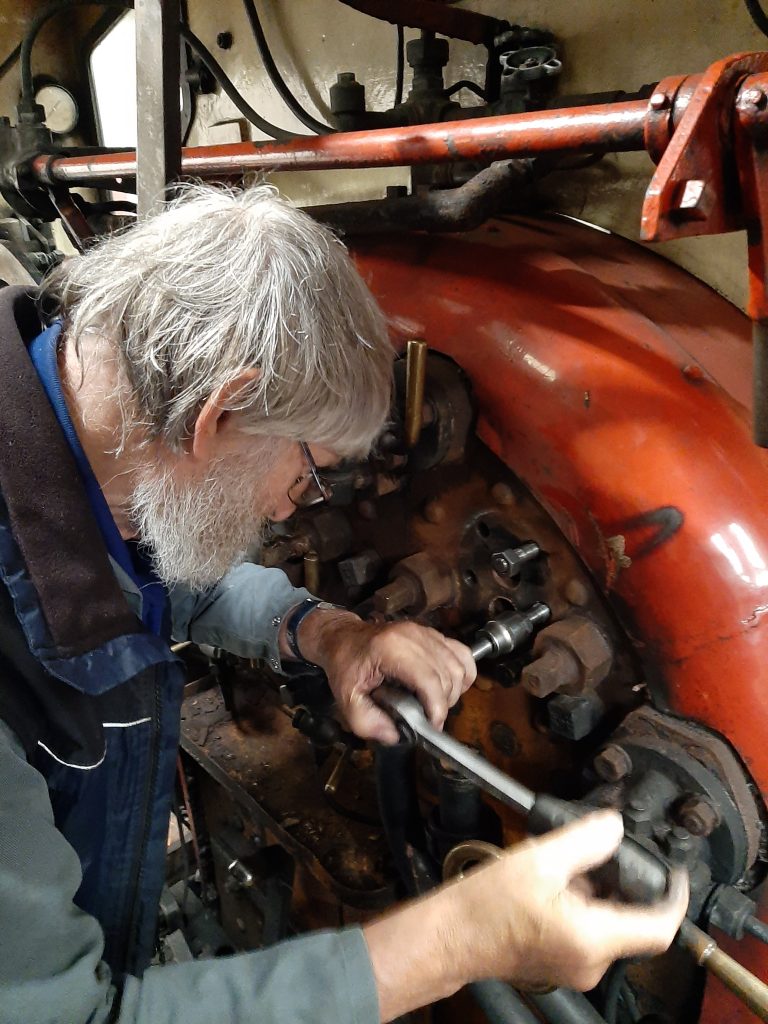 Alan then fitted the studs and until then, all was going well…..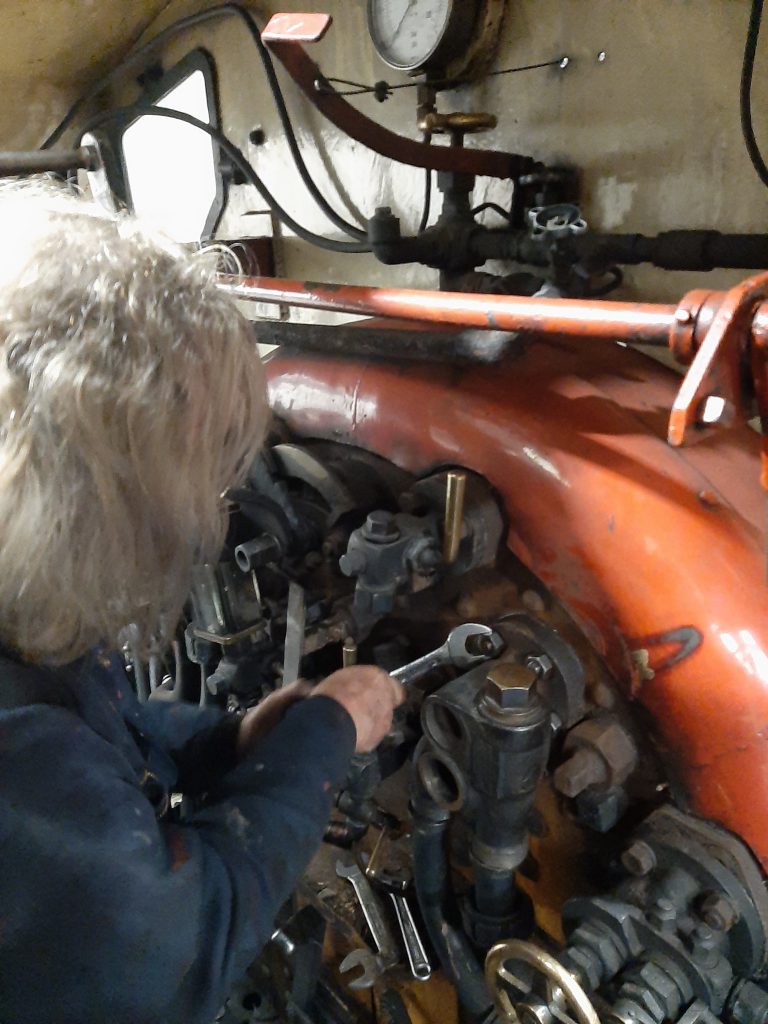
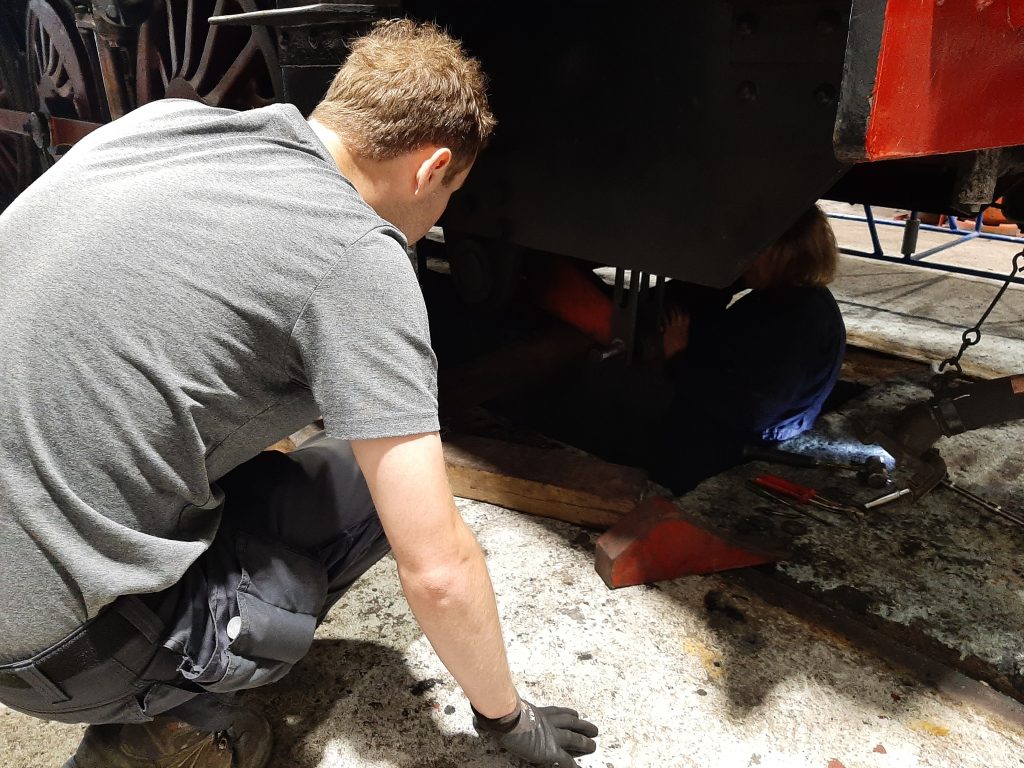 Sam is seen watching Ade under the engine during the process of fitting the links to the shaft.
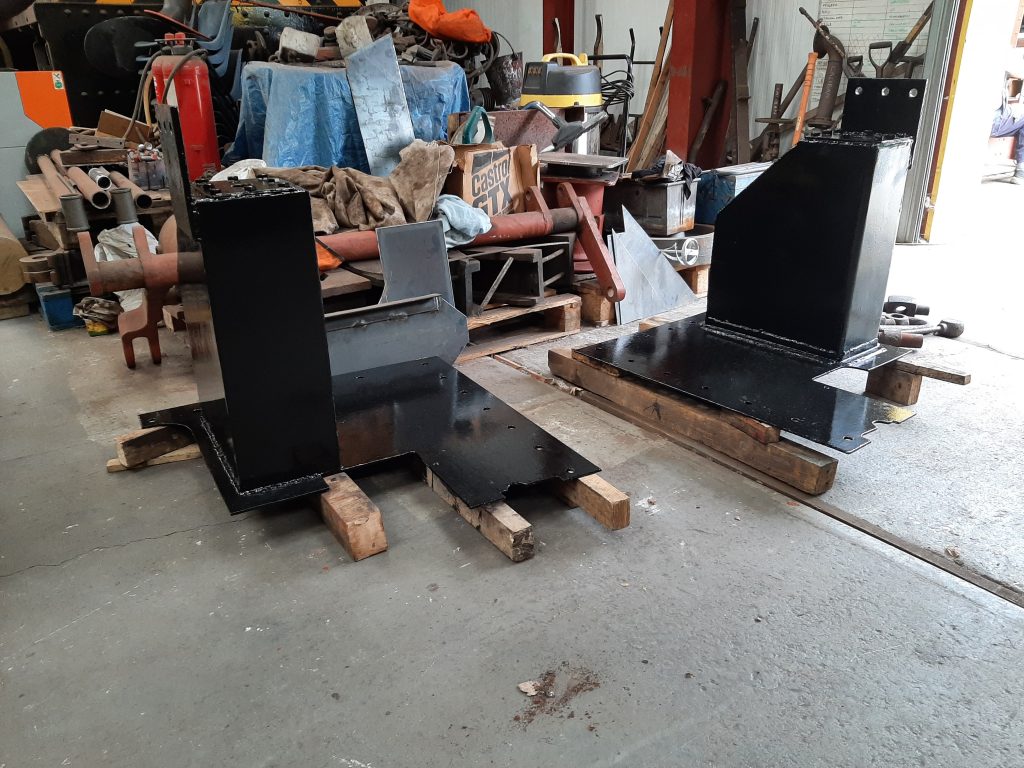 Back at Preston we have a photo of two repaired and painted sand boxes for Wootton Hall.
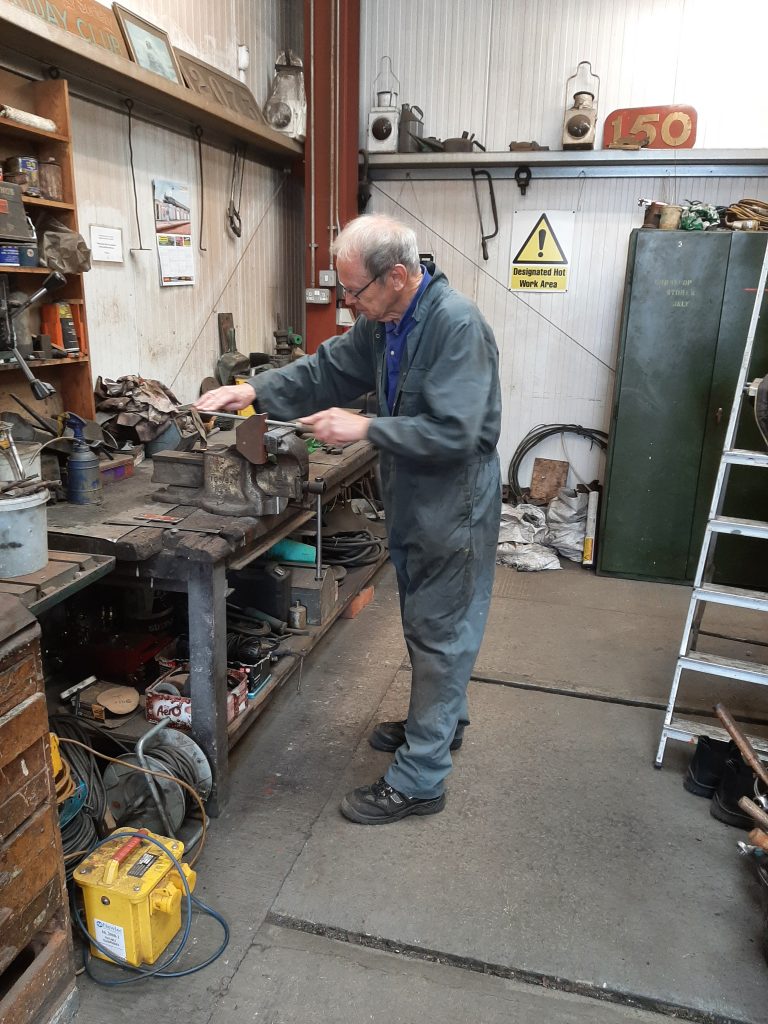 We were very pleased to welcome back John on Saturday who is seen here filing a new bracket to carry FR 20’s engine vacuum pipe.
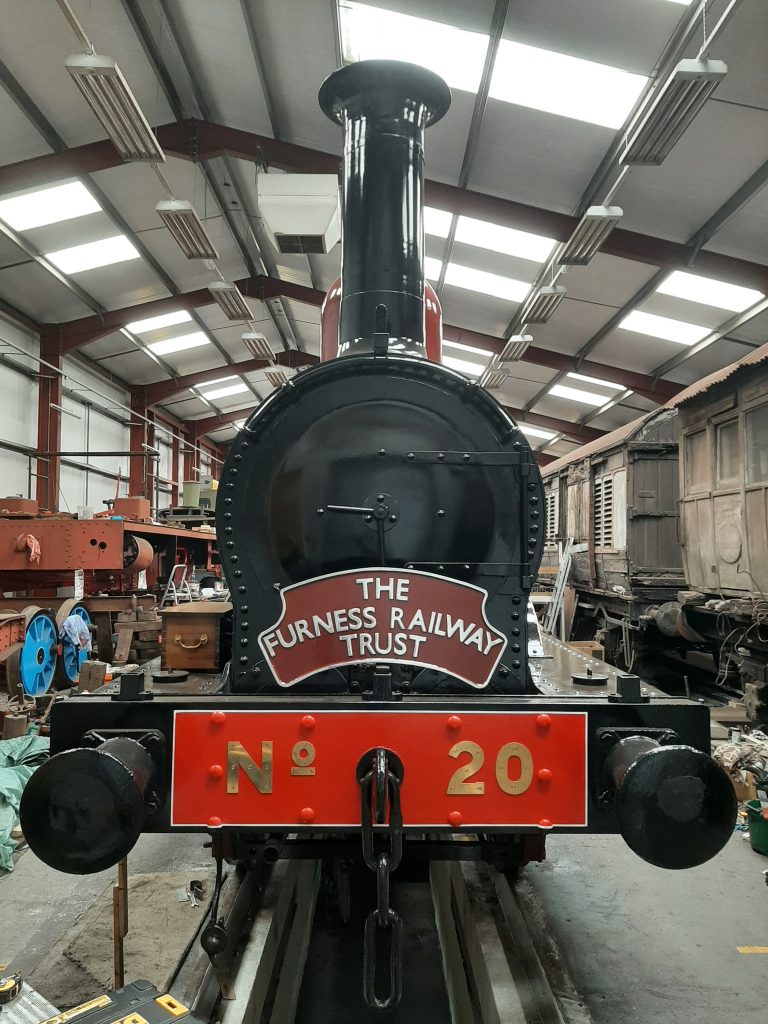 Those of you who read the blog a fortnight ago might have spotted a new locomotive headboard with the words “The Furness Railway Trust”. Sponsored by one of our members, this is now at Preston with a view to promoting the FRT and is seen on the front of FR 20.
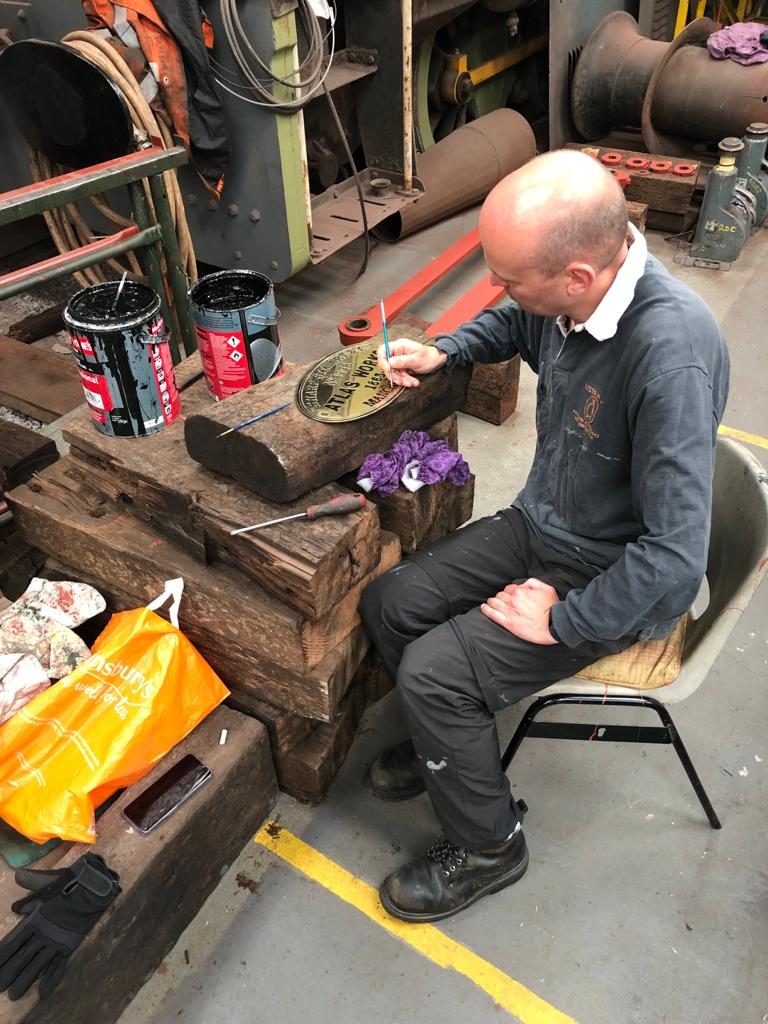 Neil appeared on Saturday to paint the inlaid sections of the works plates. These have been taken home so that a full two coats of paint can be applied.
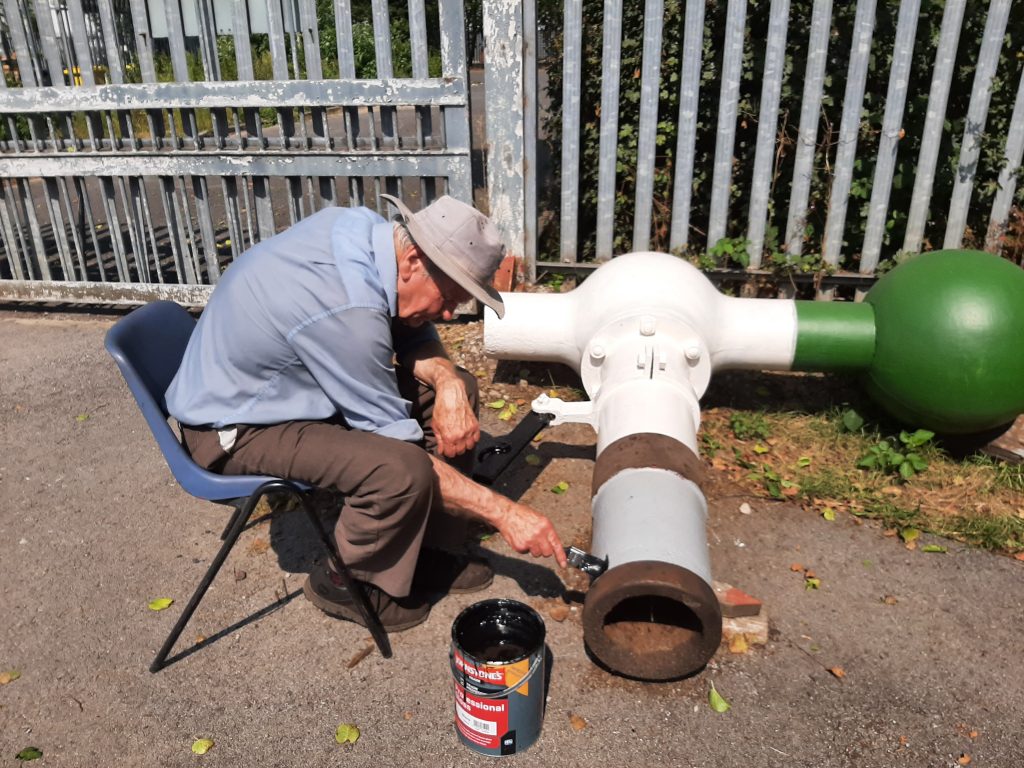 Fred manfully braved the heat on Friday and is seen here adding further paint to the water column.
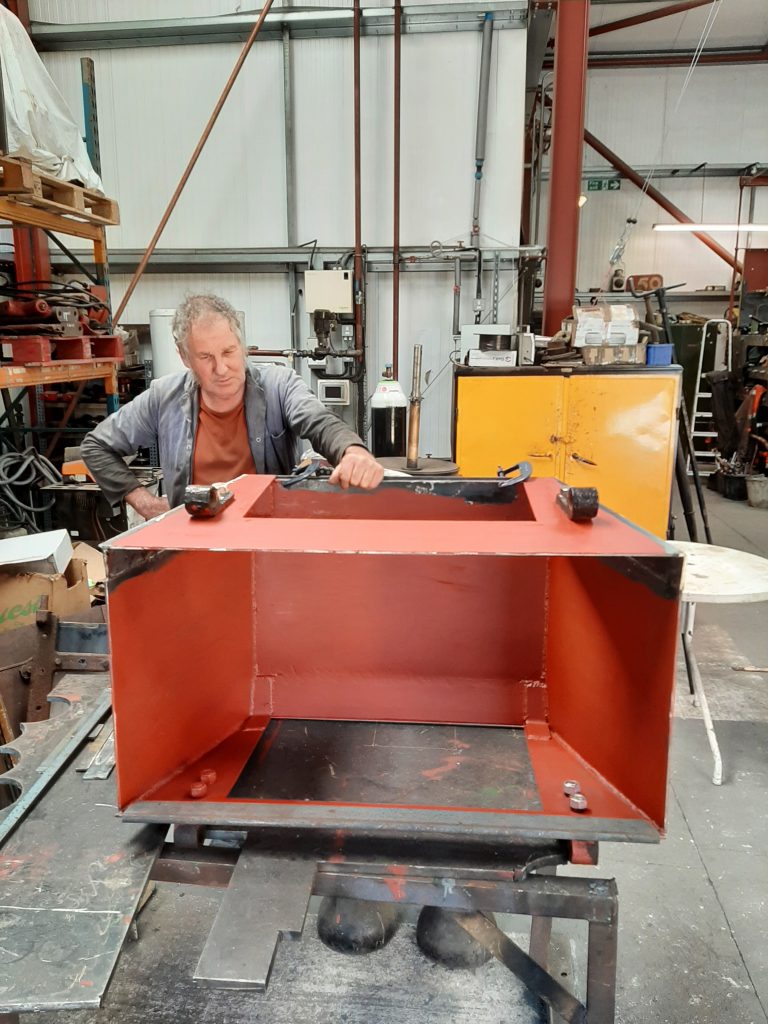 Keith has been busy manufacturing a new back lower section for Wootton Hall‘s ashpan.
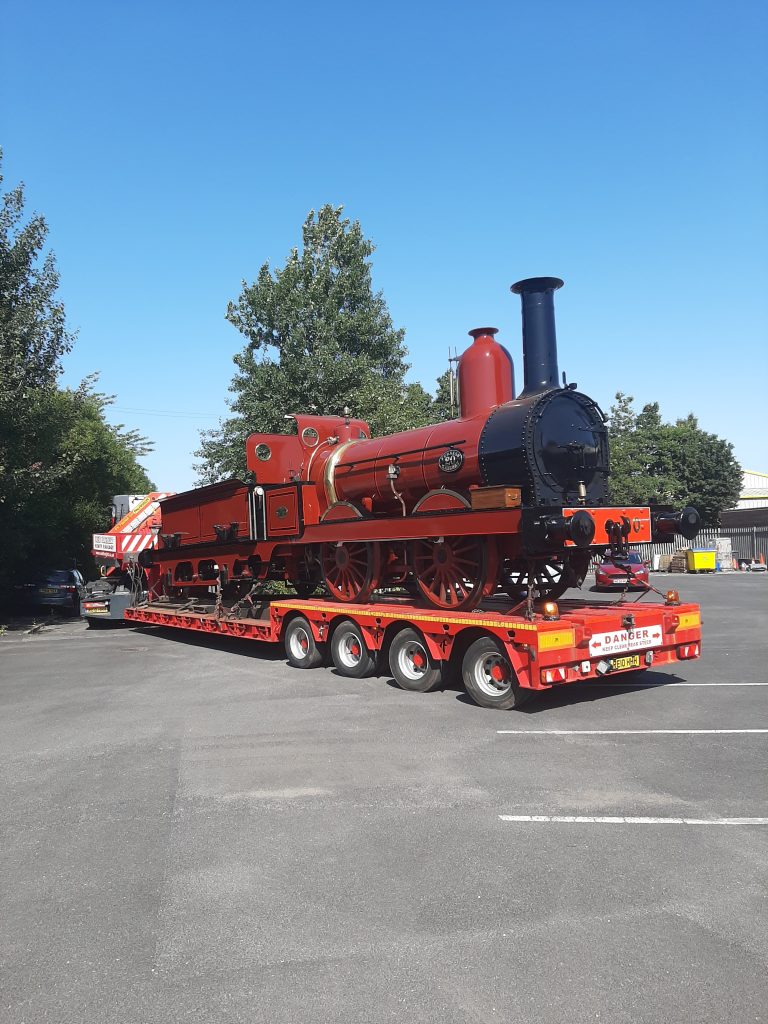 Simon Reid of Reid Freight was keen that this should be one of his more leisurely moves, as he had arranged for his family to be with him at Barrow over the weekend – rather a busman’s holiday! Simon appeared at Preston after lunch by which time Adrian had shunted FR 20 on to the loading road, which had been helpfully cleared by the Ribble Rail staff. The loco departed at 16.10 for its journey to Barrow and an overnight stopover at a secure location there – thanks to David Stubbins of the FR 175 committee, Wicks Waste Management and the Barrow Transport Group for their help.
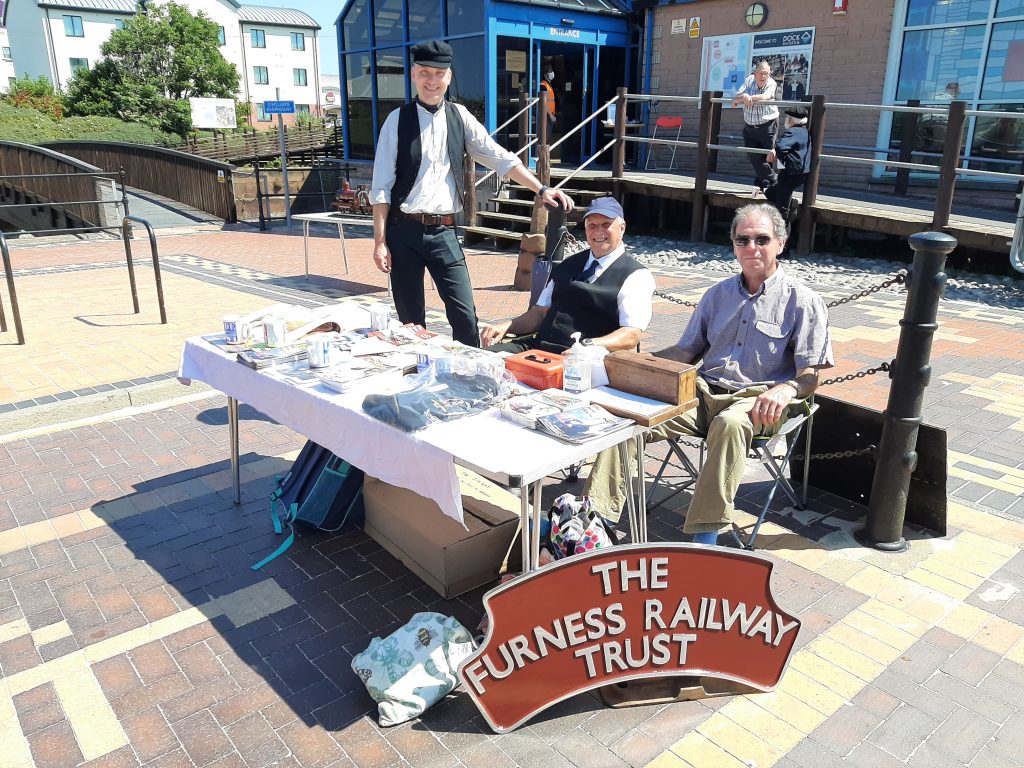 FR 20 was skilfully reversed to its allotted position behind the Dock Museum at 08.45 on Saturday morning with the sales team of Jim Kay, Andrew Furness and part time assistant Neil Smith turning up to set up the stall nearby the loco and with Peter van Zeller also making the trip down from Ravenglass to join in the fun.
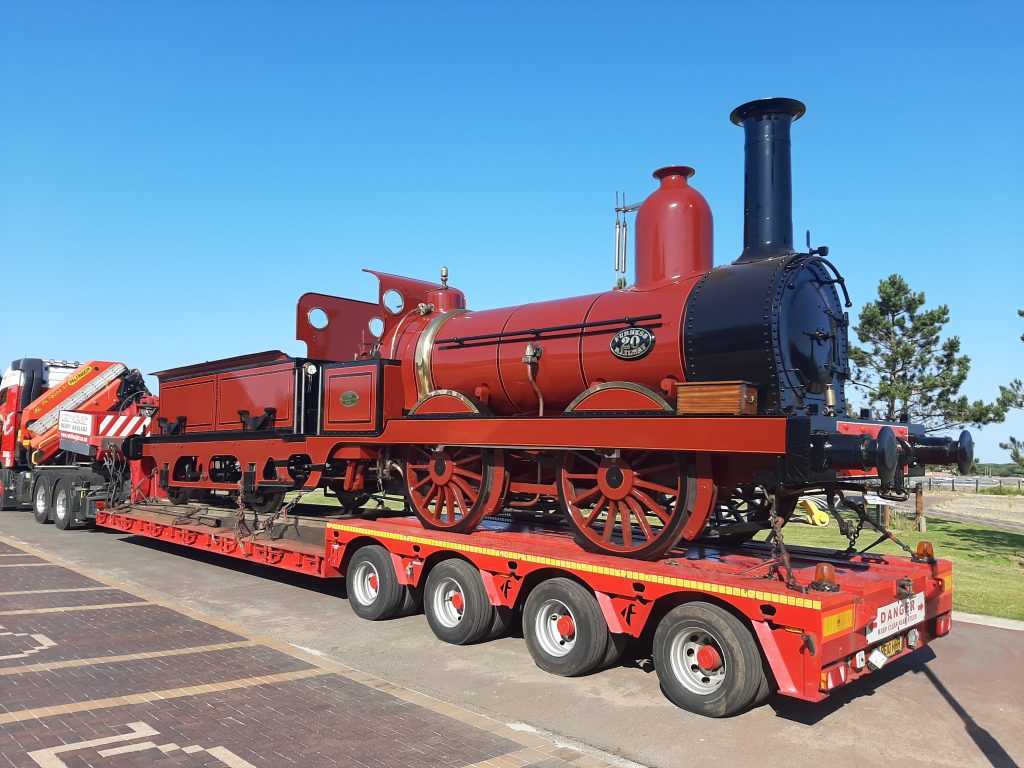 There wasn’t a cloud in the sky and everyone agreed that FR20 looked splendid in this historic and picturesque setting nearby the old Barrow graving dock. Certainly sun tan lotion was the order of the day!
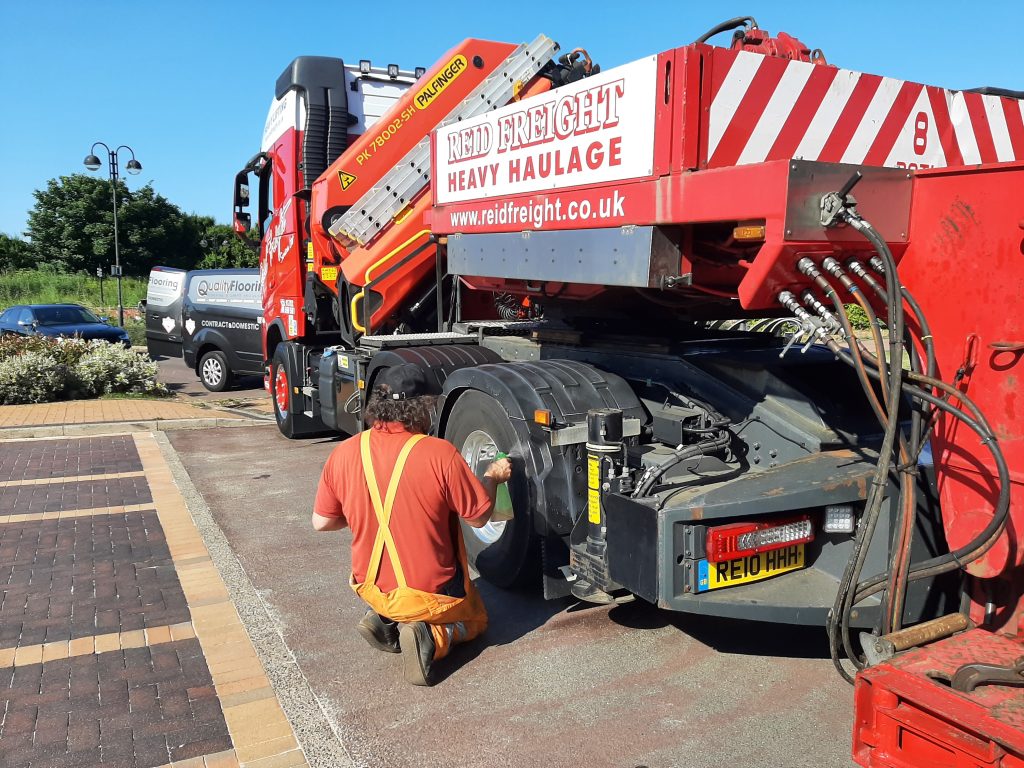 With such a sparkling loco on his rig, Simon was to be seen giving his lorry some TLC of its own!
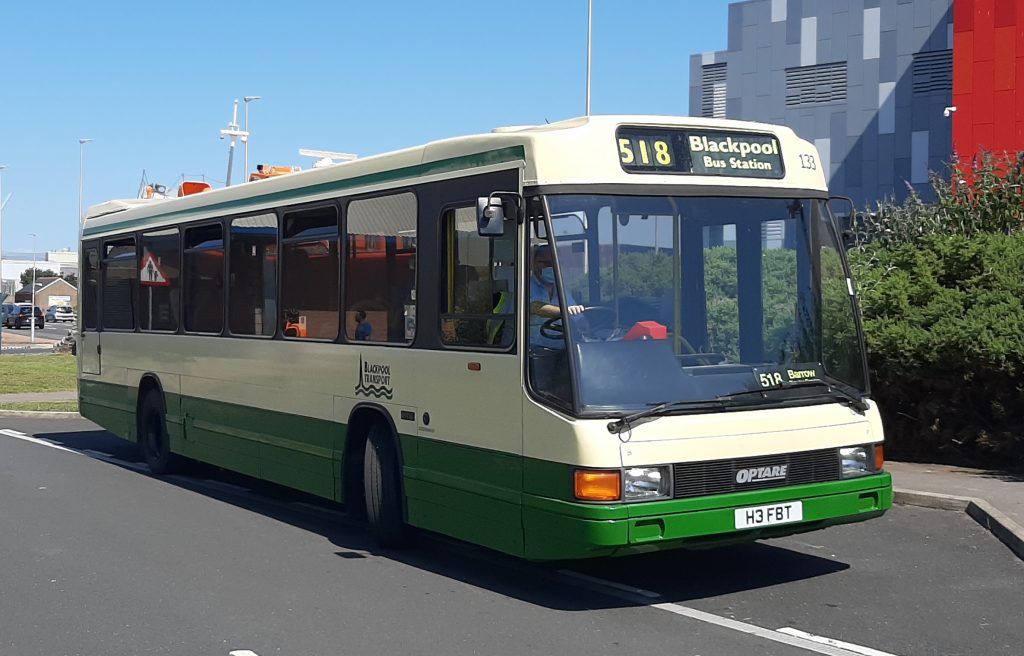 There was a well organised free bus service operated by preserved vehicles which brought new visitors to the site every 20 minutes throughout the day so, without being overrun, there was a steady flow of people who came to take photographs, chatted to us and bought souvenirs from the stall.
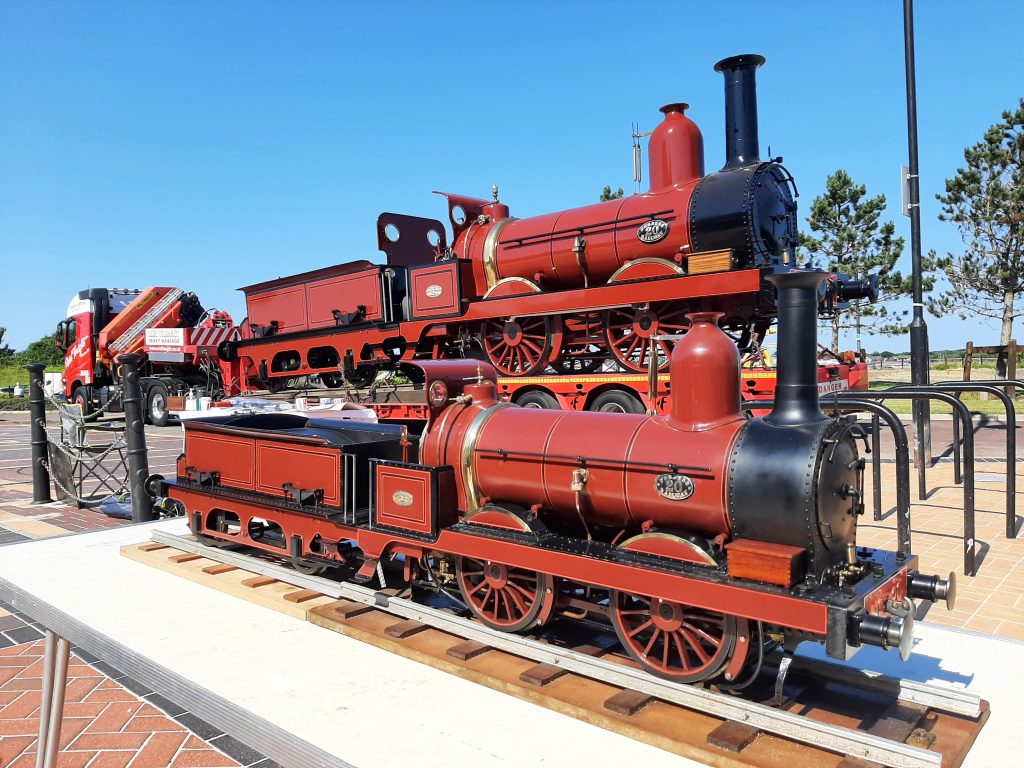 Tom Jones brought his beautiful 5″ gauge working model of FR 20 for it to be displayed alongside the 12″ to the foot version and which received many accolades.
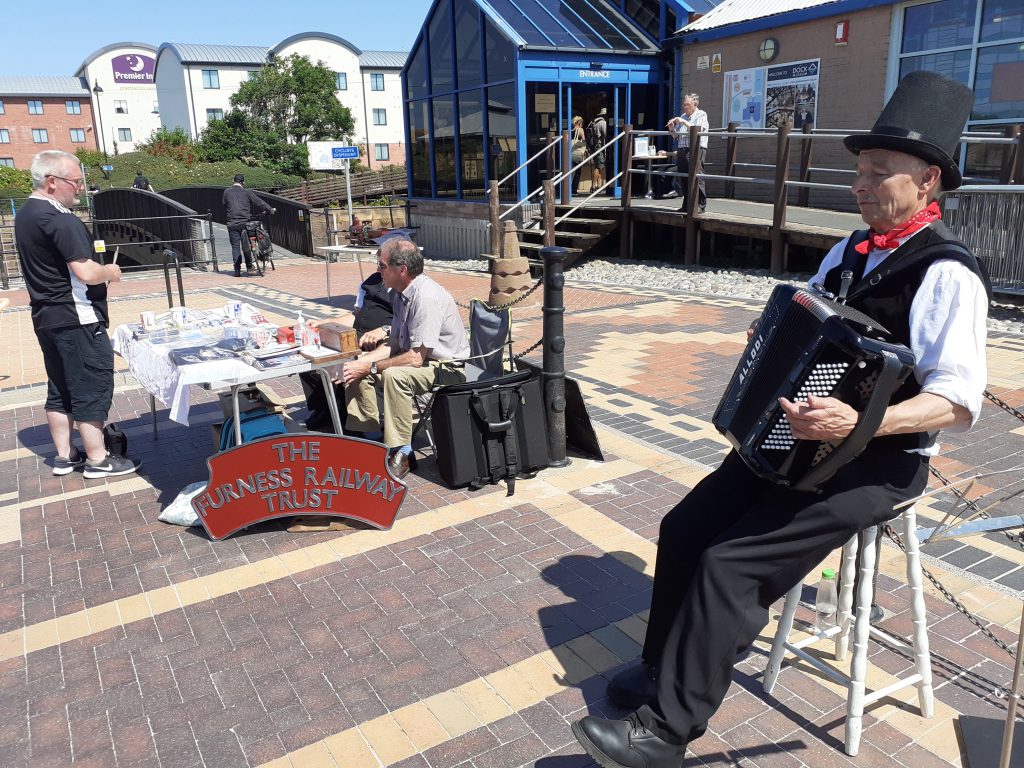 Nearby there were also stalls operated by the FR 175 committee, Community Rail Cumbria and the Lakes Line Rail User Group amongst others. There were children’s entertainers and, in the afternoon, Tim took the opportunity to reprise some of the songs from the FR 150 road show The Iron Road.
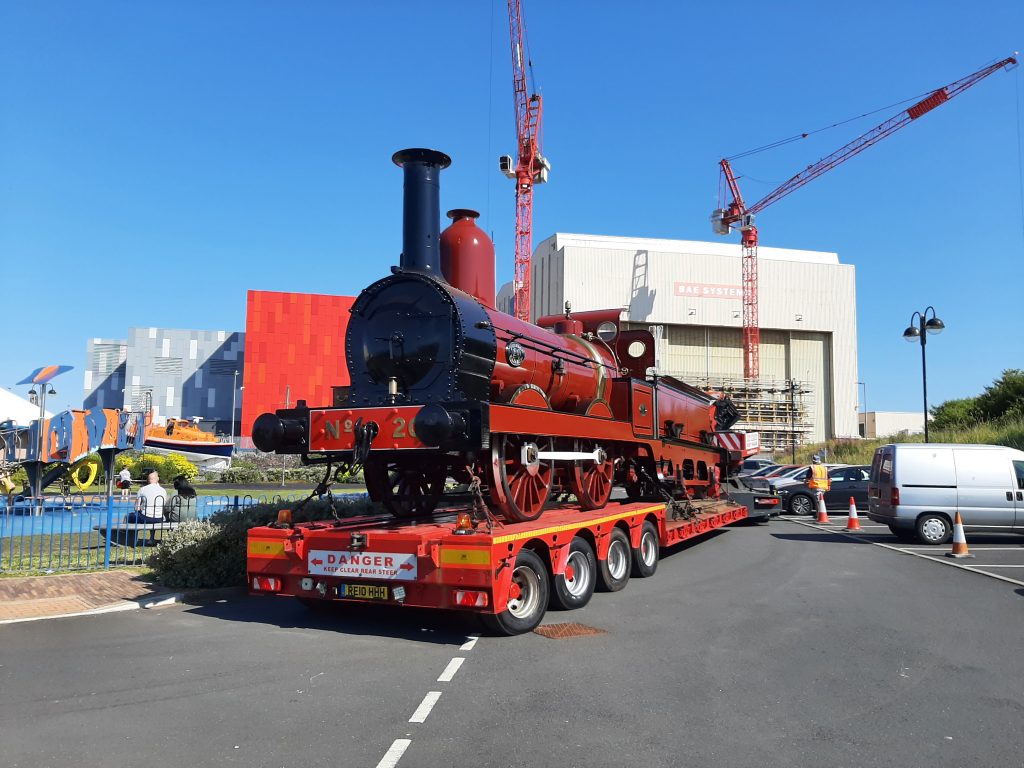 All too soon though, 16.00 hrs arrived and it was time to pack up and then wave goodbye to FR 20 as, with a farewell toot on the Reid Freight horn, it left the site by the towering Devonshire Dock Hall of the shipyard, where FR 20’s restoration took place from 1996 to 1998. All in all, a very successful and memorable day at a very well organised event.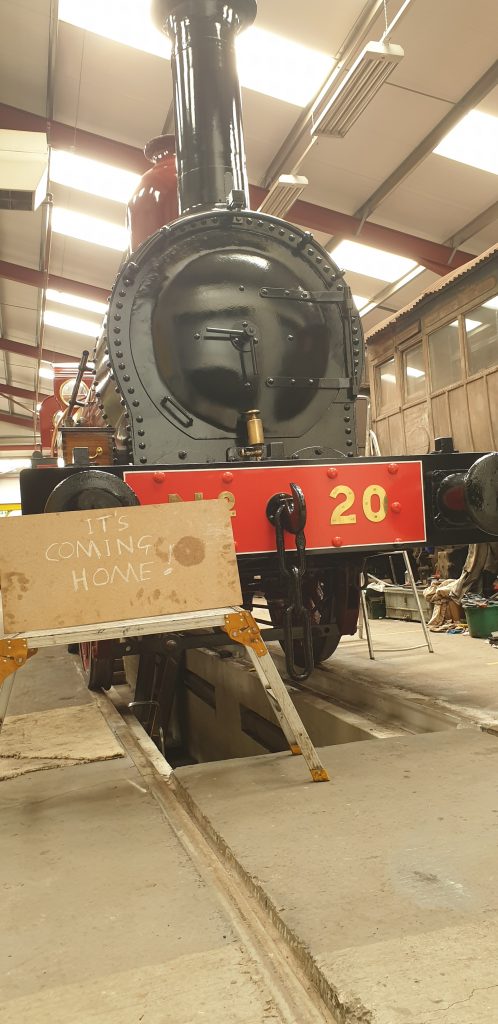
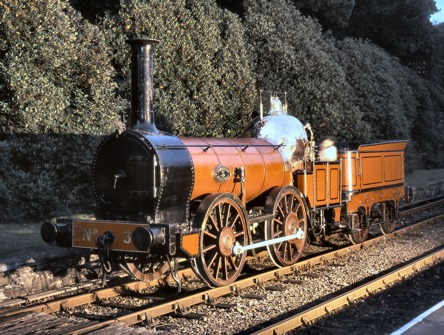 Those of you with good memories will recall that 25 years ago, at the 150th anniversary of the Furness Railway, Furness Railway Number 3, aka Old Coppernob was brought “home”, posing outside Barrow station where it had stood for over 4o years in a glass building after retirement, and visiting the Lakeside and Haverthwaite Railway (above).
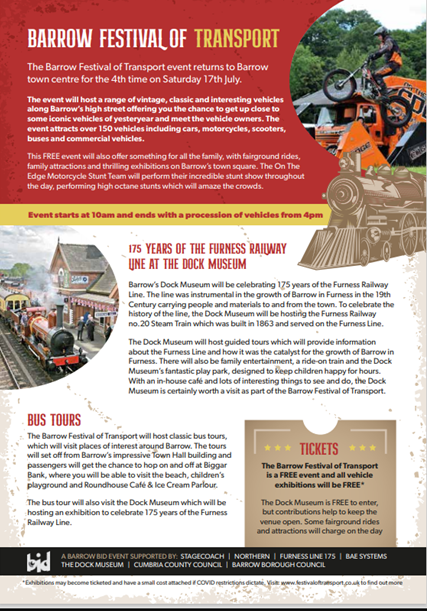 FR 20 will be exhibited at the Dock Museum in Barrow and the FRT will have a stall there to sell souvenirs and to explain the work of the Furness Railway Trust. Volunteers to assist would be most welcome. Please contact Tim Owen so that arrangements can be made.
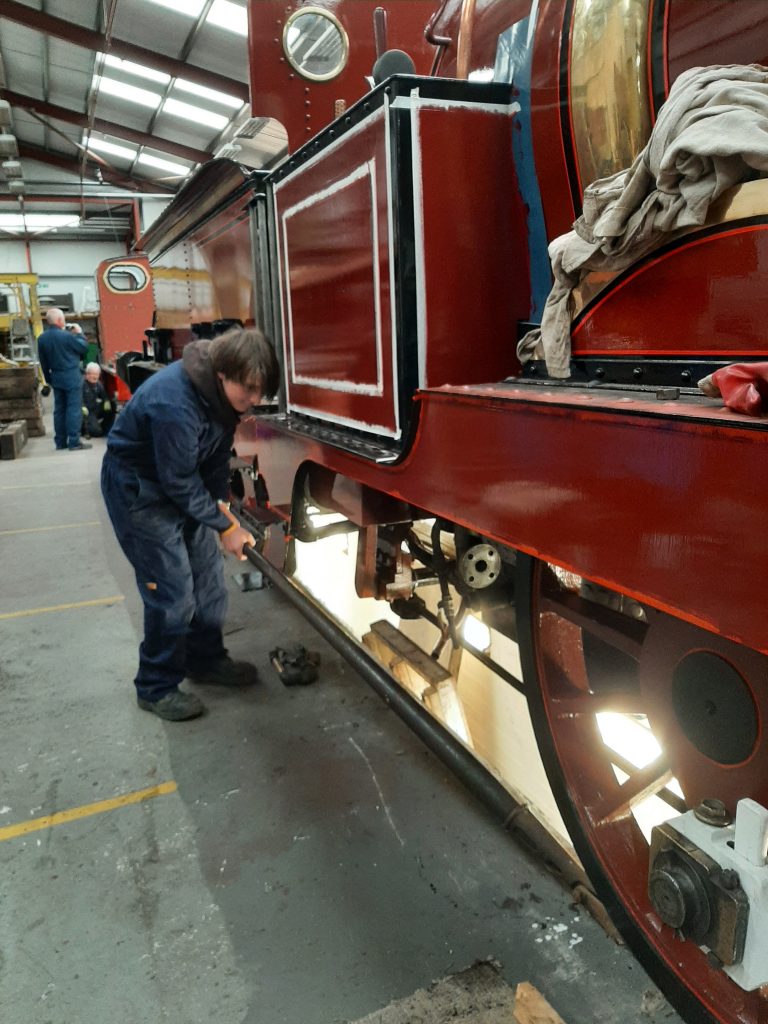 At that stage, the fitting of the engine’s vacuum pipe had not been resolved. Last Wednesday, Matthew was given the task of moving the locomotive forward with a pinch bar to see whether the coupling rod would clear the latest position of the pipe. Unsurprisingly, others were also called on to assist before a full revolution of the wheels was achieved. And always it is wise to remember that it is best to check that all chocks have been removed to avoid deflating the confidence of the guy working the pinch bar!?!
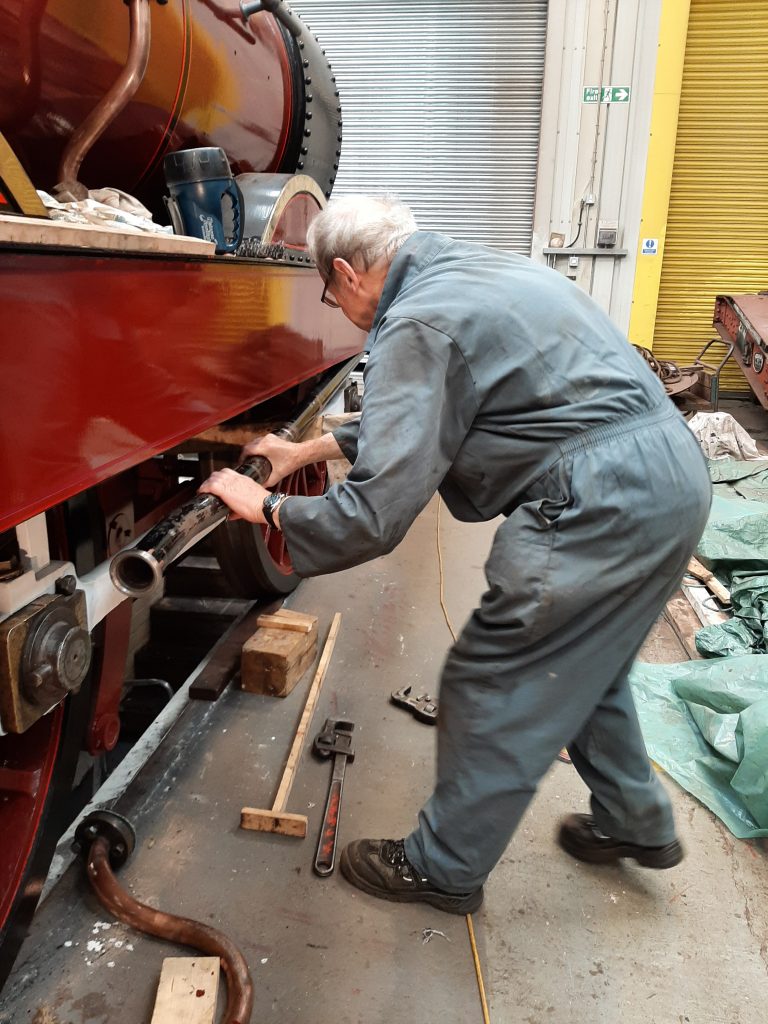 John Dixon returned on Friday and Saturday to continue his quest to get the various pieces of pipe to fit, cursing the constrained space below the valance.
 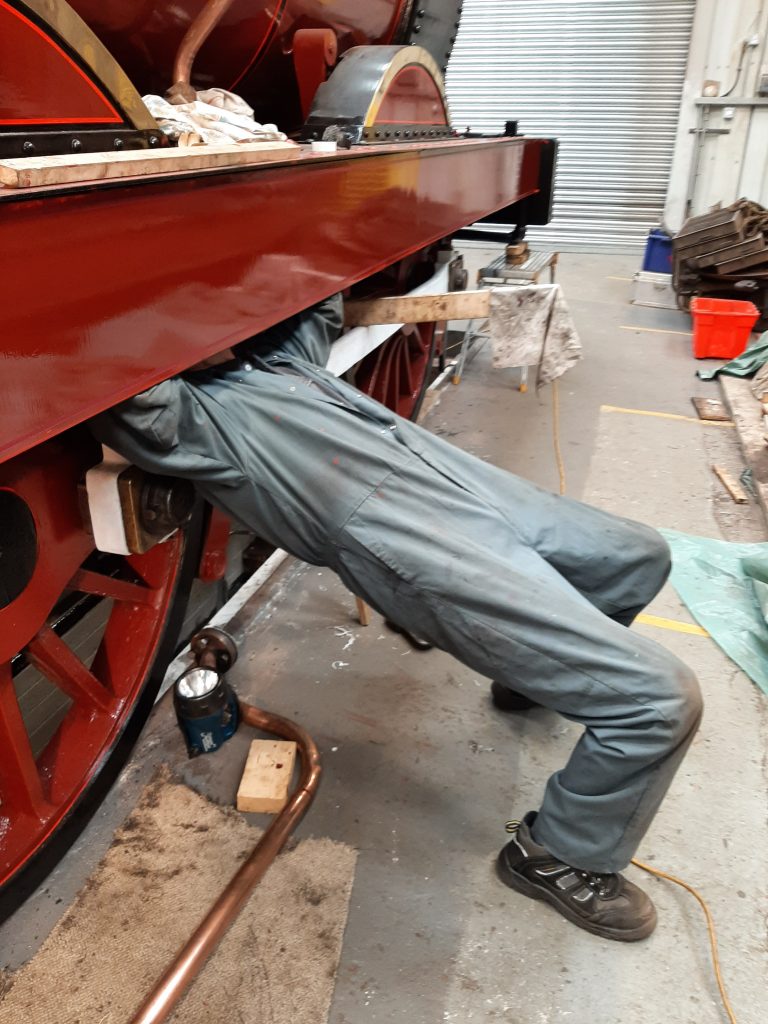 Eventually we all heard John exclaim loudly, “The gods are with us – the bxxxxxd fits!!” (Was that really our John?) Needless to say, relief all round.
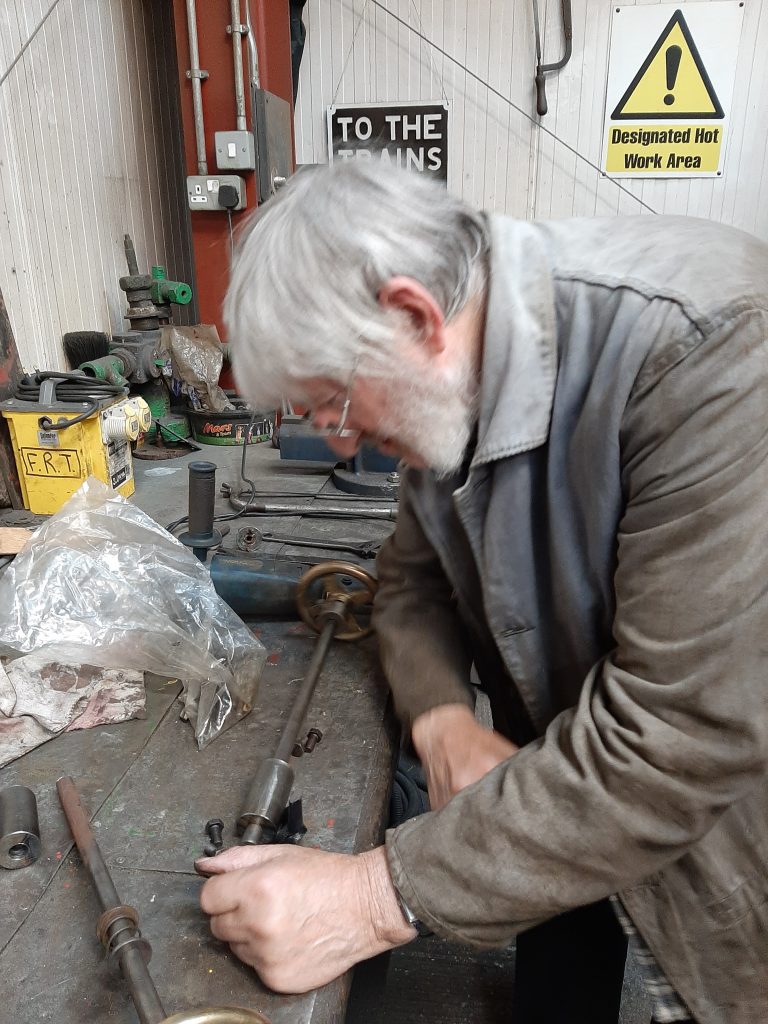 Alan has been busy with the assistance of Sam fitting the remaining pipework and fittings and working out how best to modify the existing handles and spindles to control the new injector steam valves from the cab.
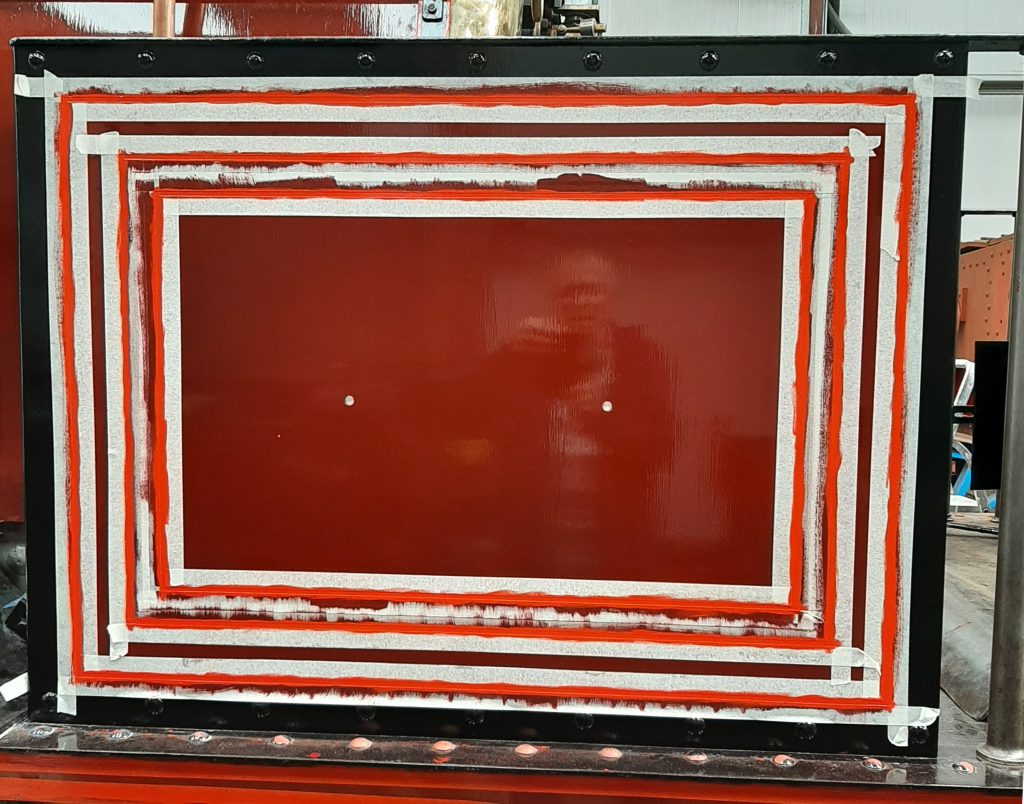 Tim also made an appearance on Saturday to try and complete the lining of the cab sides and valances in time for the filming. The complex pattern of masking tape on one of the cab sides can be seen last thing Saturday evening and then the reveal on Monday morning before the loco was pulled out of the shed.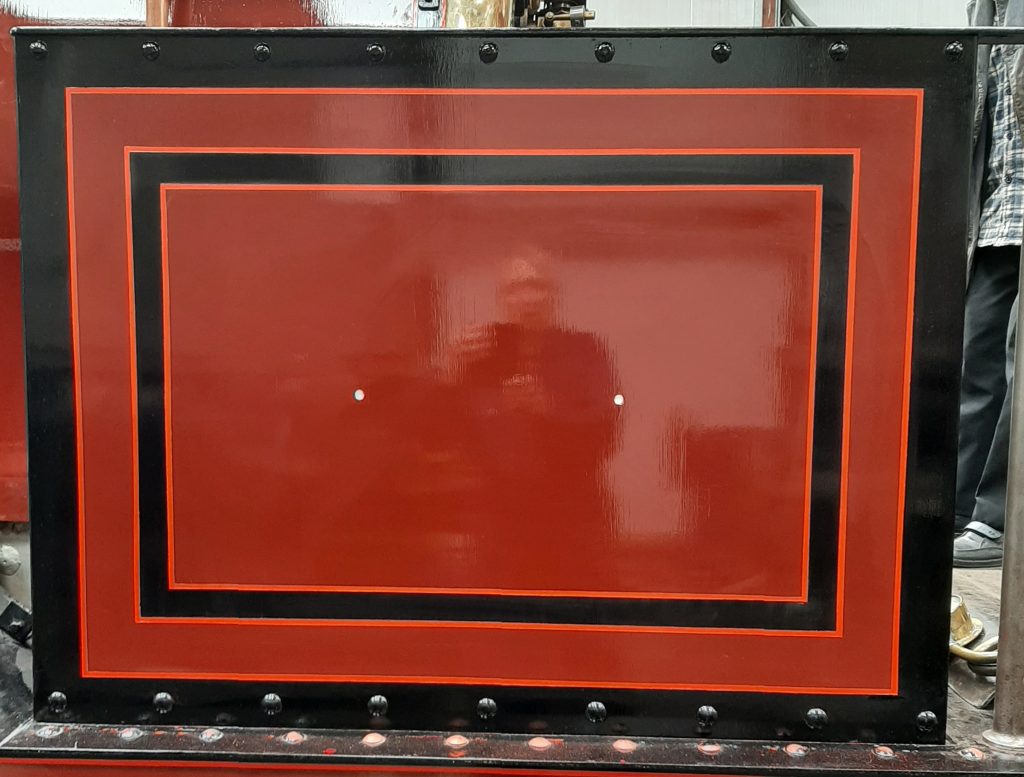
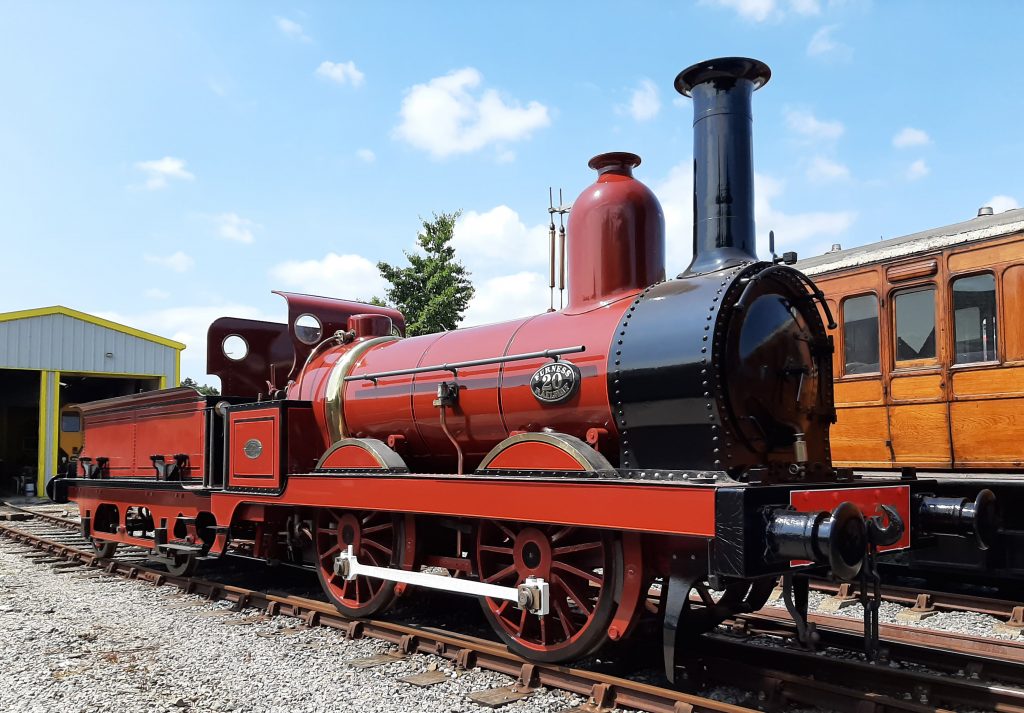 FR 20 was then pulled out of the shed into the outside world for the first time in many months alongside the FRT’s Great Eastern Railway Royal Saloon No. 5.
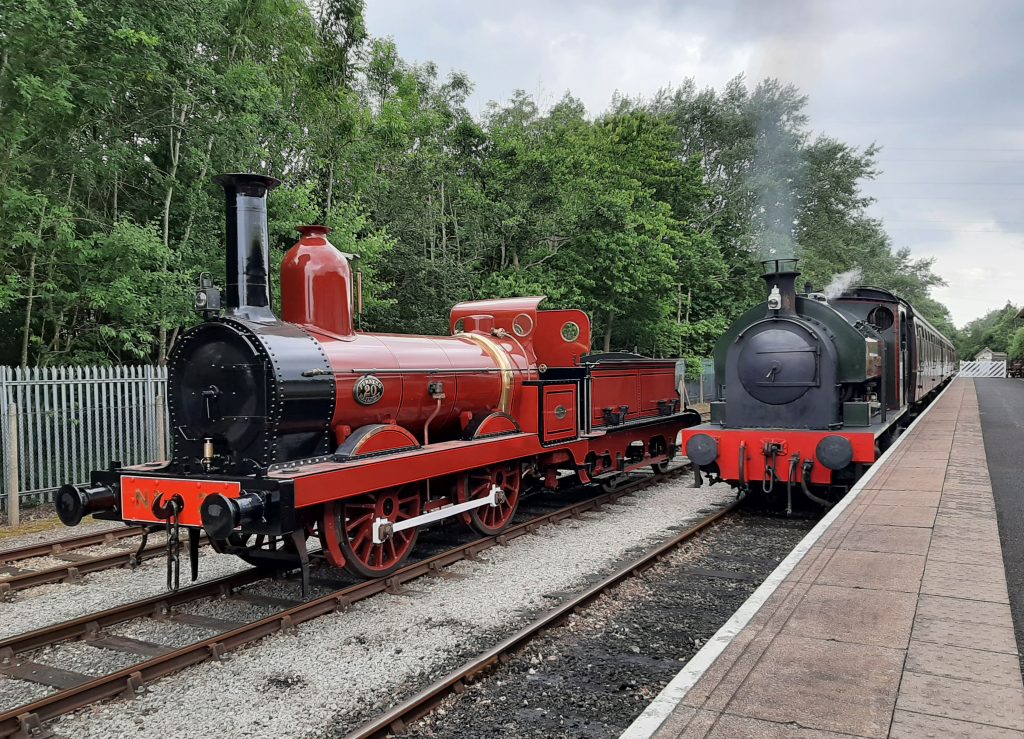 The programme’s director then asked for FR 20 to be positioned on the centre road opposite the Riverside platform. Whether or not you will see FR 20 on the programme is debateable as most of the filming featured RSR’s Bagnall 0-6-0 Courageous hauling a three coach train with Ade on the regulator.
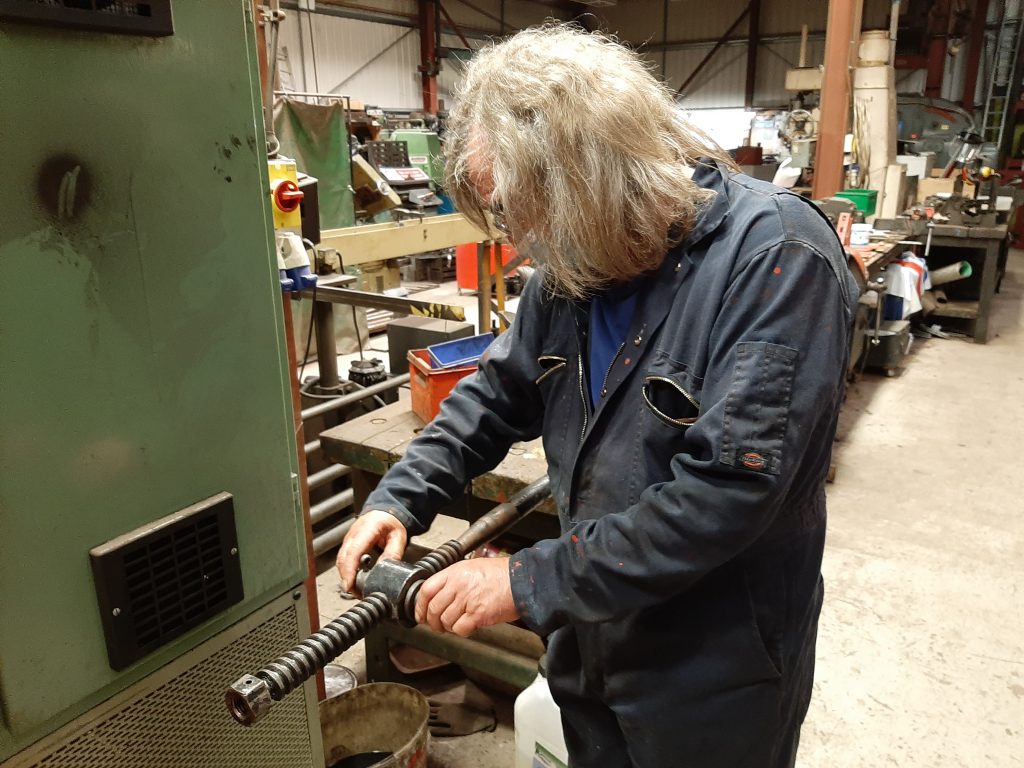 There has also been some work on Cumbria‘s components this week. Ade is seen testing the handbrake nut on the shaft. The general opinion was that there is relatively little wear on the screw, however, uneven wear was found on the lugs on the handbrake nut which could be the cause of the problems experienced with the handbrake.
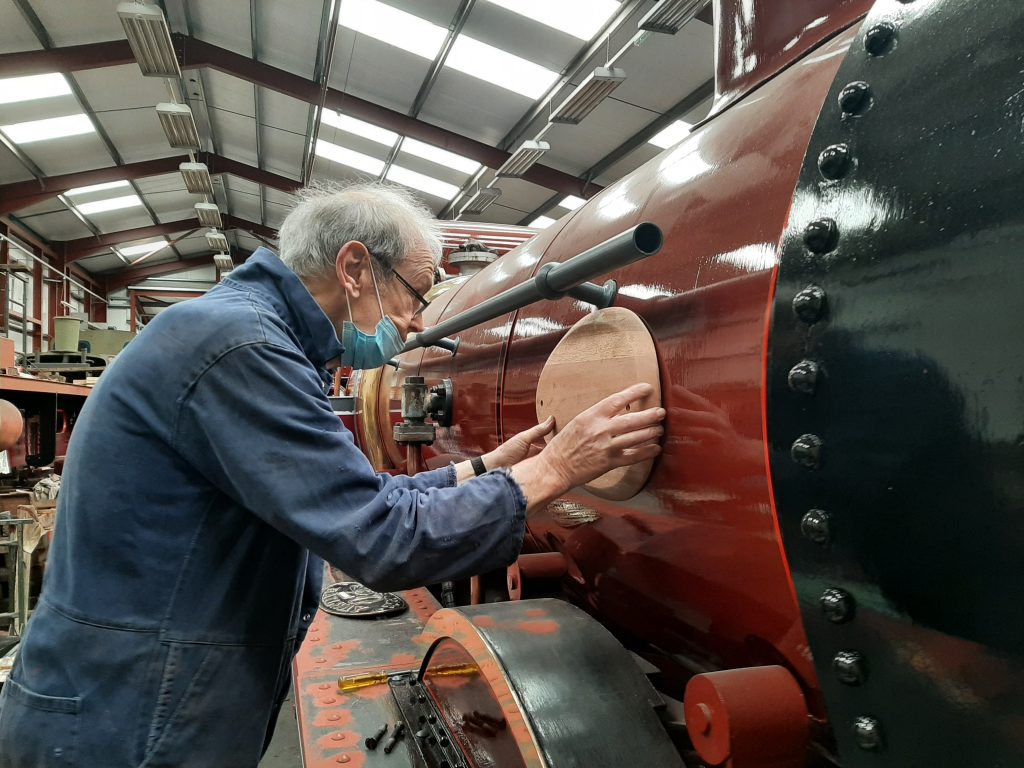 John Dixon arrived to see whether his homework, a new wooden pattress for one of FR 20’s numberplates, would pass the test – the previous pattress had succumbed to rot on the lower side. The result looked pretty good to us!
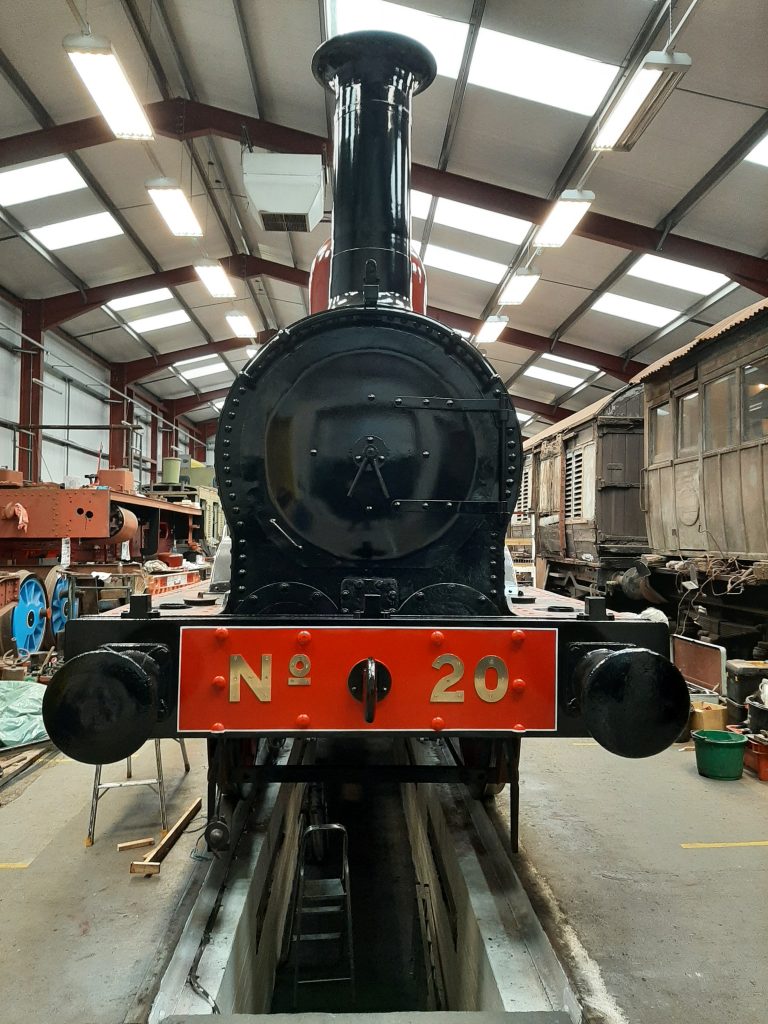 The painting of the front of the engine has now been completed and Ron and Tim polished and fitted the brass letters and numbers on to the buffer beam.
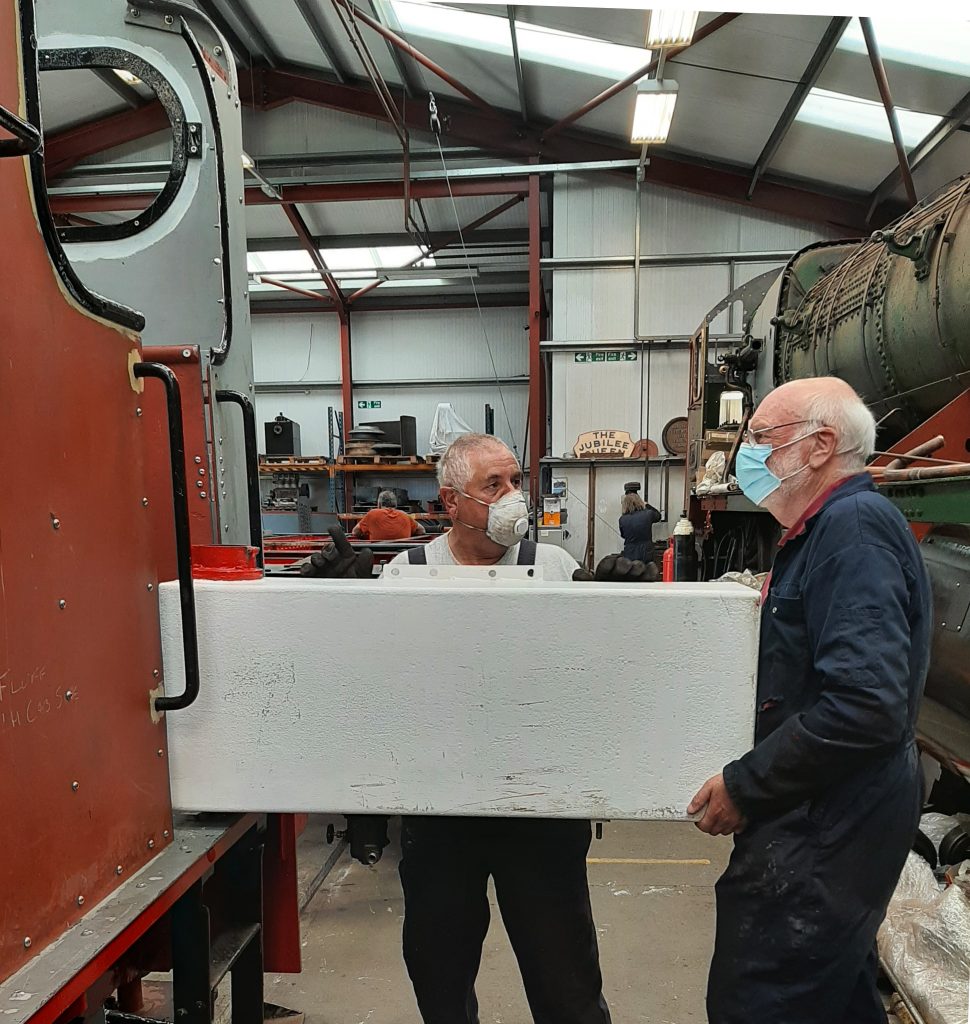 The Fluff team reached the stage where they needed to refit the fuel tank and John Davis and Phil are seen here loading it into the cab.
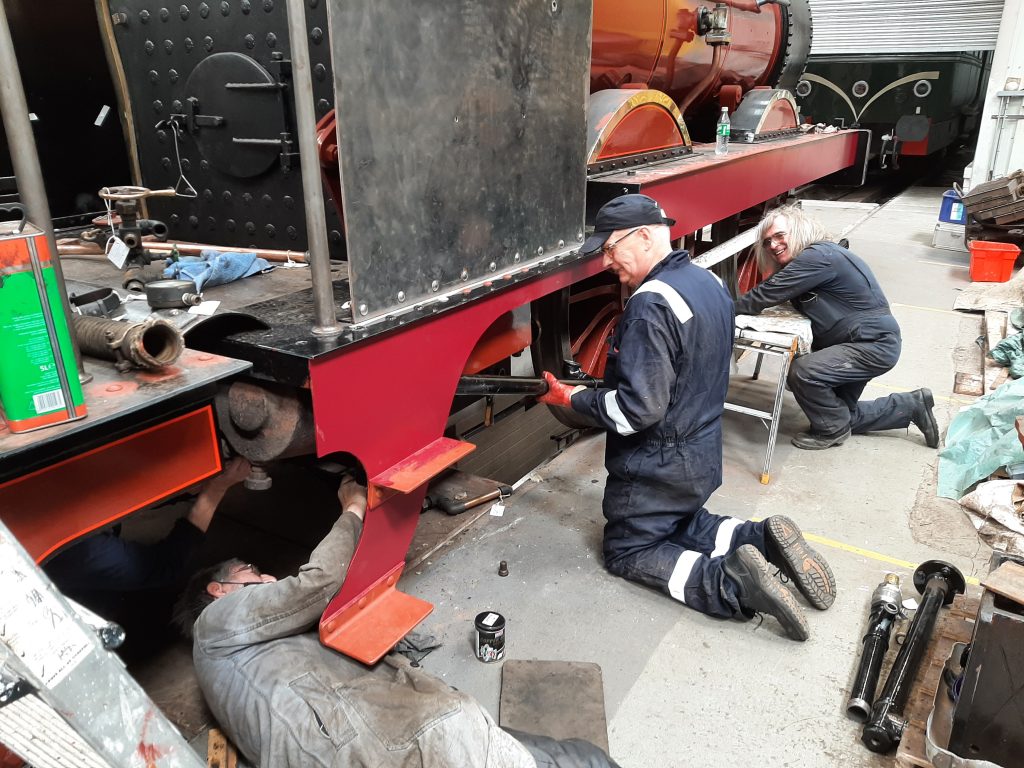 Last Wednesday saw some progress on re-fitting the engine’s vacuum pipe which, for some reason, is proving to be a challenge. John Dixon, Alan, Ron and Ade are seen here wrestling with the recalcitrant pipework.
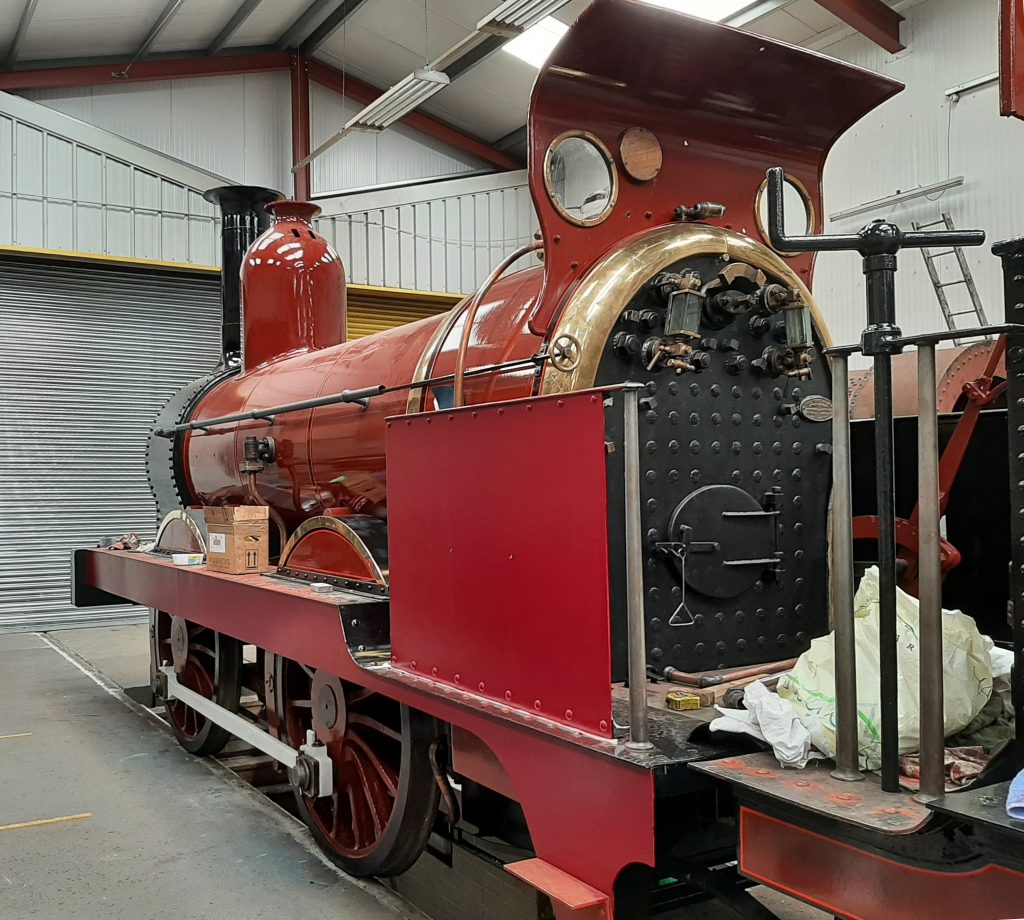 The cab sides have now received coats of primer and undercoat as part of the push to complete the paintwork.
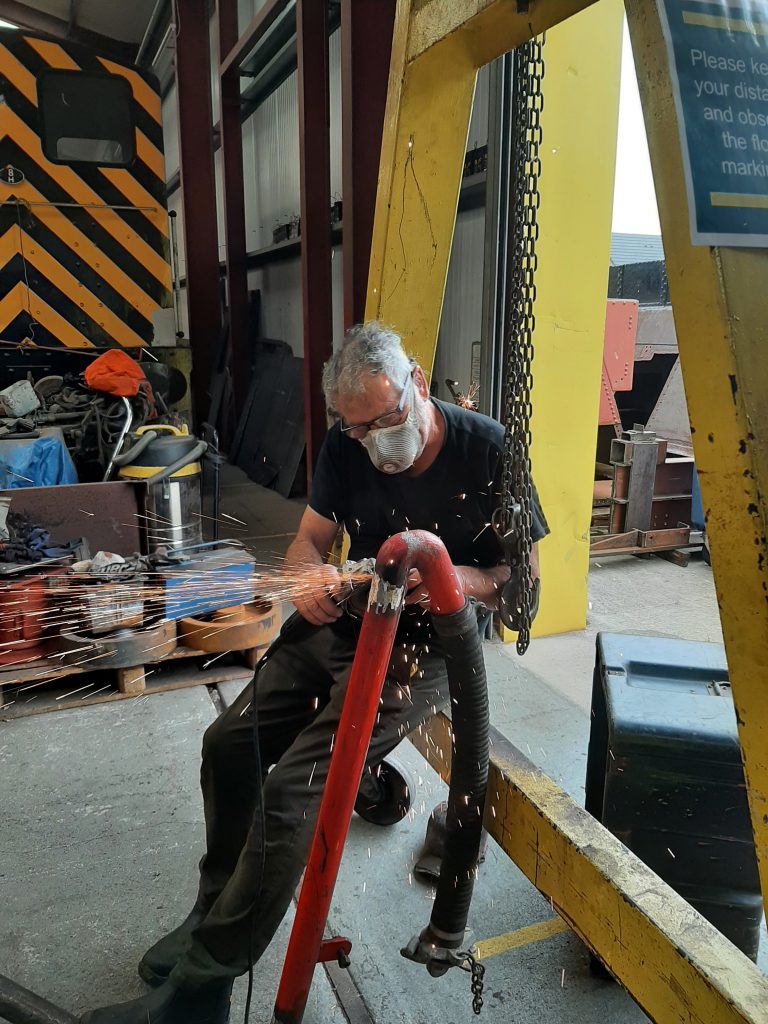 Work has also continued on Wootton Hall‘s tender where Fred has been cleaning up the vacuum pipework and Keith has been welding up and grinding off any suspicious areas of metalwork.
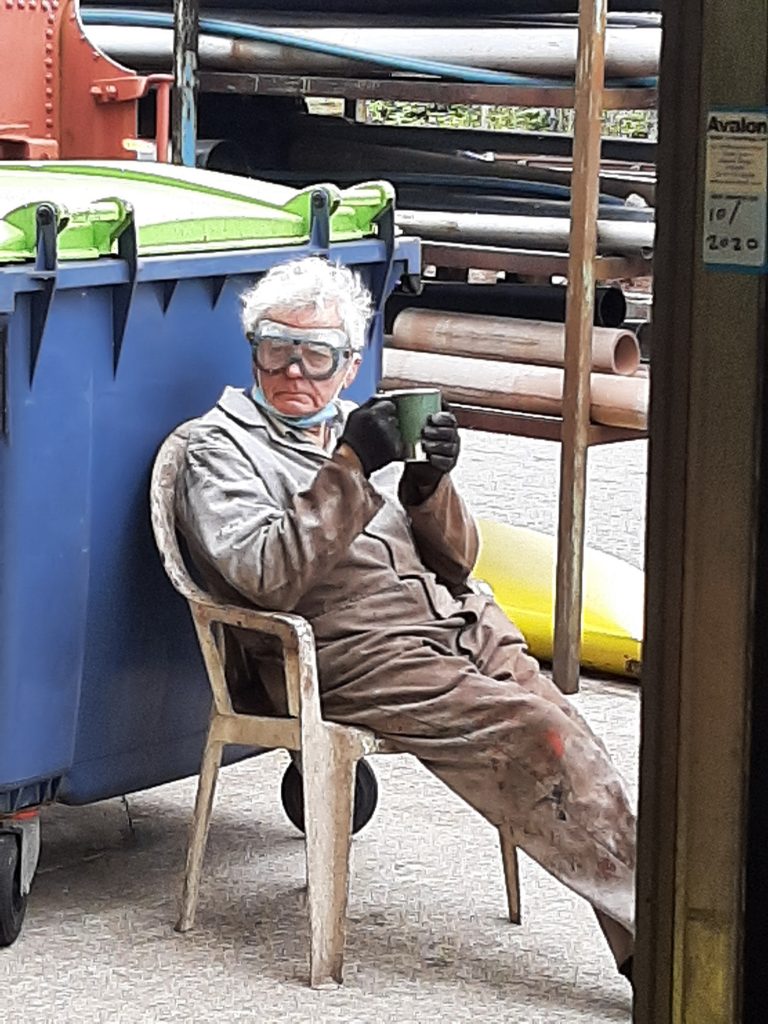 Fred is seen here taking a well earned break – he will be glad to know that the next box of cup wire brushes has arrived!
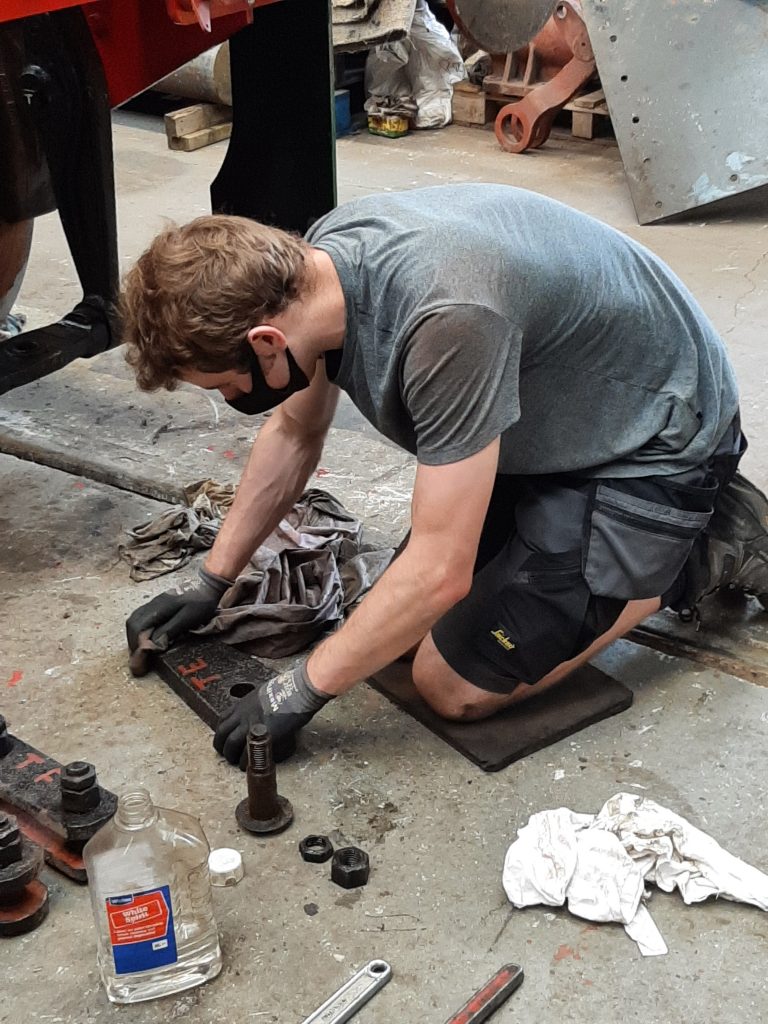 Sam was kept busy on Friday cleaning and piecing together the tender brake linkage.
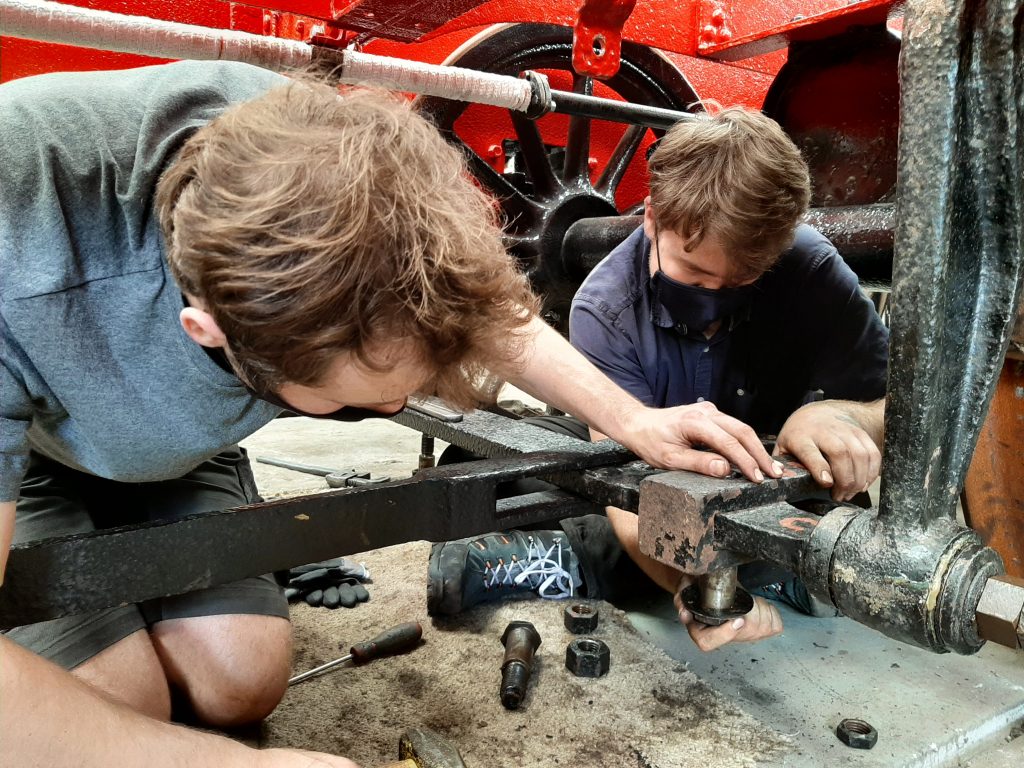 Sam was so enthused by the task that he appeared again on Saturday to fit the linkage with a helping hand from RSR’s new recruit, Jack Davenport.